
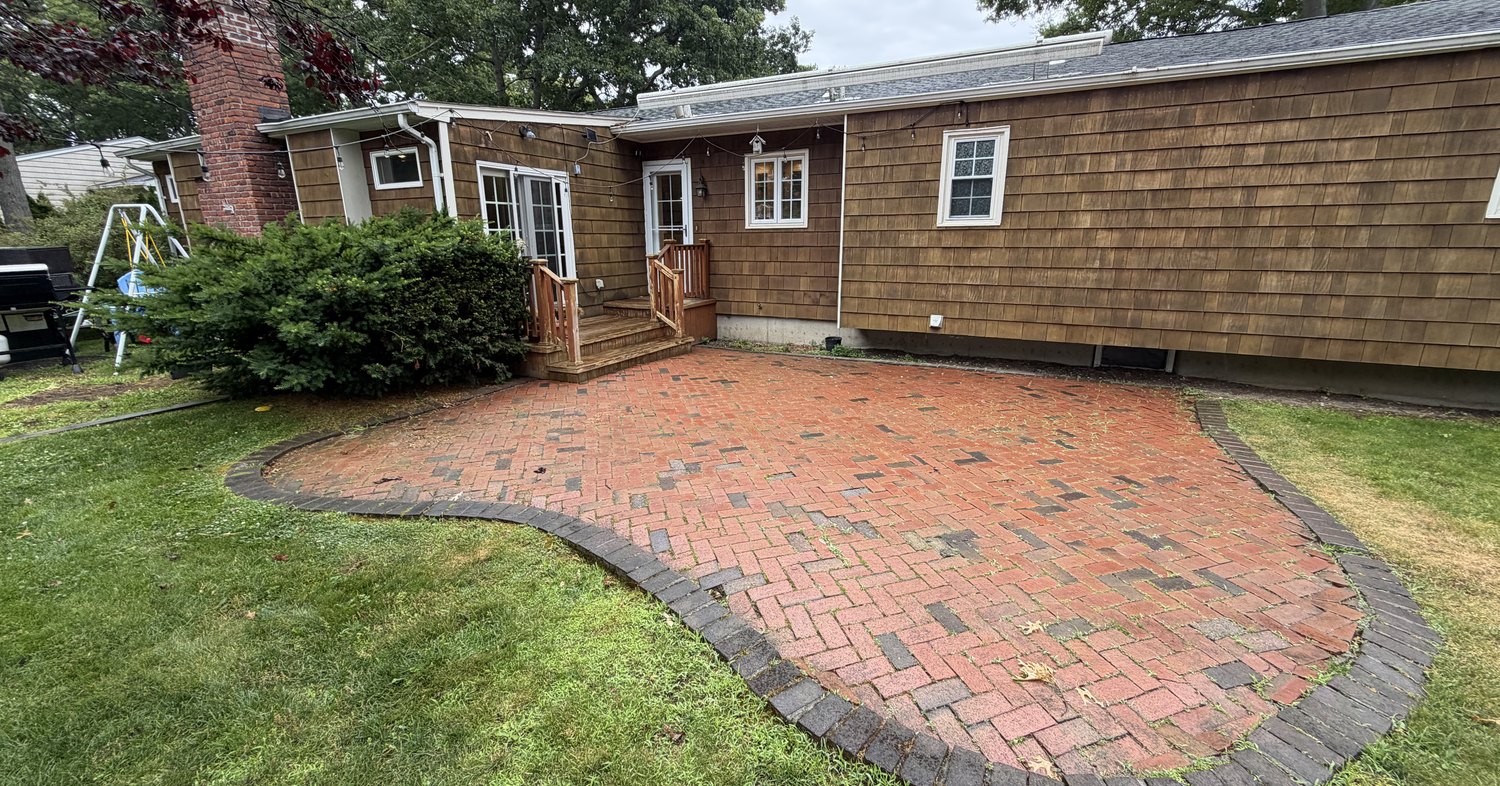
Paver patio repair Nassau County homeowners keep putting off usually starts as one small clue: a puddle that sits an hour after rain, or a single unit that tips under your heel. Long Island patios rarely fail all at once. One of four layers under the surface gives up first, and the surface tells you which.
We have built patios here for more than 15 years and finished more than 2,000, so this is a diagnostic guide, not a repair manual. You get seven signs, the layer failing behind each, how urgent it is, and the published range that scope of paver patio repair Nassau County work falls into.
Quick answer: Standing water, a rocking unit, joints widening 1 to 2 feet in from the edge, joint sand dropped past 1/2 inch, a lip underfoot, ruts on the walked line, and heave that never settles. Each names a failed layer, and the layer sets the paver patio repair Nassau County scope.
Table of Contents
The Four Layers Under Every Paver Patio Repair Nassau County Job
A paver patio is a flexible pavement, so failure is never random. Every paver patio repair Nassau County job traces back to one of four layers, and each fails in a way you can read.
- Base: the compacted aggregate that carries load. Depressions come from base or subgrade never compacted enough.
- Bedding sand: a thin screeded layer that beds the unit, starts interlock, adds structure and drains water arriving through the joints.
- Edge restraint: the perimeter that keeps units tight and takes horizontal push.
- Joint sand: the sand between units, which transfers shear from paver to paver.
Bedding sand runs 1 inch nominal loose, 3/4 to 1 inch compacted. It is not a leveling course and will not rescue a base screeded out of grade. Load it with fines and it stops draining: a spec allowing 3 percent fines can cut permeability fivefold.
Signs 1 to 4: Standing Water, Rocking Units and Lost Sand
Sign 1, water standing after rain. That is a base or subgrade problem, not a surface problem. We lay a 10 foot straightedge across the depression and measure the maximum depth down to it.
Sign 2, a unit that rocks or drops under your foot. The bedding sand below has washed out or lost structure. It is local, it spreads, and it is cheapest to correct while it is still one paver.
Sign 3, joints opening near the perimeter. Edge restraint failure shows up 1 to 2 feet in from the pavement edge, as joints widening outward. That detail is the most diagnostic thing on the patio, and it never stops on its own.
Sign 4, joint sand more than 1/2 inch low. CMHA calls for refilling immediately, because joint sand transfers shear between units. That is where paver patio maintenance stops being cosmetic, and where the paver patio repair Nassau County scope grows if you wait.
Signs 5 to 7: Lips, Ruts and Long Island Winter Heave
Sign 5, a lip that catches your foot. Two units are out of plane, from bedding sand loss or a base dip starting underneath. The public benchmarks are useful here: PROWAG R302.6 and the 2010 ADA Standards allow 1/4 inch vertical, a 1:2 bevel from 1/4 to 1/2 inch, and a 1:12 ramp above 1/2 inch.
Those rules govern accessible routes and the public right of way, not a private backyard. We borrow them because a foot does not know jurisdictions.
Sign 6, ruts down the line everyone walks. Base thickness or stiffness is short, or the bedding sand carries too many fines. In one documented case those fines reached the drains below, the sand liquefied, pumped up through the joints and the pavement was ruined.
Sign 7, winter heave that never settles back. Heave needs three things at once: frost susceptible soil, freezing temperatures in it, and water. Ice lenses crystallize in the voids. Silts, classified F4, are worst, then sands and gravels with excess fines, F3.
Those conditions are never uniform across a yard, so the heave is not either, and that is the crooked surface you meet in April. That is why a paver patio repair Nassau County inspection is worth doing once the ground has thawed, not before. Our post on why paver patios sink digs into the causes.
| Sign | Layer failing | Urgency | Repair it leads to |
|---|---|---|---|
| Standing water | Base or subgrade | This season | Regrade, recompact |
| Rocking unit | Bedding sand | Soon, it spreads | Reset on new sand |
| Joints widening at edge | Edge restraint | Urgent | Rebuild perimeter |
| Sand 1/2 inch low | Joint sand | Immediate | Refill, then seal |
| Lip underfoot | Bedding sand or base | Urgent, trip risk | Relevel those units |
| Ruts on walked line | Base or sand fines | Soon | Rebuild that run |
| Heave that stays | Frost susceptible subgrade | Plan for spring | Drainage, base rebuild |
Not sure which layer is failing? We name it on site, before anyone quotes a number, with estimates back in 12 to 24 hours. Our workmanship on any paver patio repair Nassau County job is backed by the same 3 year warranty we give on new work.
The White Haze Is Not Damage
Most homeowners who call about a white film assume the pavers are ruined. They are not. Calcium oxide inside the unit meets capillary water and becomes calcium hydroxide, which rises, reacts with carbon dioxide in the air and dries as calcium carbonate.
Manufacturer guides, Cambridge among them, and CMHA describe it the same way: an appearance issue, not a structural one. Rain carries it off over time, and it stops appearing in roughly 18 to 24 months. No paver patio repair Nassau County visit should be selling you a cure for it.
Cracked pavers repair is the opposite case. A split unit is real damage, though normally it means swapping one unit. When several units split in the same spot, we check the base underneath before swapping anything, because a soft base keeps breaking whatever sits on it.
Salt, Joint Sand and Paver Patio Maintenance
Joint sand washes downslope and keeps leaving if nothing holds it. CMHA recommends routine attention twice a year, spring and fall, sweeping dry masonry sand across the surface so the joints stay full. Sealing is the other lever, and our paver sealing cost page covers that.
On de-icers CMHA is specific. Rock salt, sodium chloride, is the least damaging to concrete materials and should be used where possible, while magnesium chloride and CMA are not recommended, because they chemically degrade all types of concrete. NRMCA adds that ammonium sulfate and ammonium nitrate must never be used.
Clay brick reacts differently. De-icers can overcool the surface and shock it, and in Class NX or MX brick that shows as spalling. On Long Island only Class SX belongs outside, and a paver patio repair Nassau County crew should confirm which you have.
What Paver Patio Repair Nassau County Work Costs
We do not price paver patio repair Nassau County work by the square foot, because until the units come up nobody knows how much base is bad. These are the ranges we publish, and they move with scope.
- Spot repair: $150 to $400
- Section repair: $350 to $900
- Releveling: $750 to $2,000 and up
- Full base rebuild: $3,000 to $8,000 and up
Patio repair cost lands in one of those bands based on how much base must be opened, and cracked pavers repair can land anywhere in them, depending on what the base looks like once the units come up. Our guide to fixing sunken pavers covers the work itself.
Schedule a free repair assessment. Tell us what you are seeing and we will look at it anywhere in Nassau County, or call (631) 275-3142, 8AM to 5PM Eastern.
Frequently Asked Questions
How do I tell a spot fix from a full rebuild?
Count the failures. One rocking unit or a single low corner is a spot job. Depressions in several places, ruts along a walking line, or joints opening around the perimeter say the base is short, and base work is the durable answer.
Does the white haze mean the pavers are defective?
No. Calcium hydroxide travels to the surface, meets carbon dioxide and dries as calcium carbonate. Manufacturer guides and CMHA both treat it as cosmetic. Rain washes it away, and it stops appearing within roughly 18 to 24 months of installation.
How often should joint sand be topped up?
CMHA recommends routine attention twice a year, spring and fall, sweeping dry masonry sand across the surface so joints stay full. Any joint sitting more than 1/2 inch low gets refilled right away instead of waiting for the next season.
What drives patio repair cost the most?
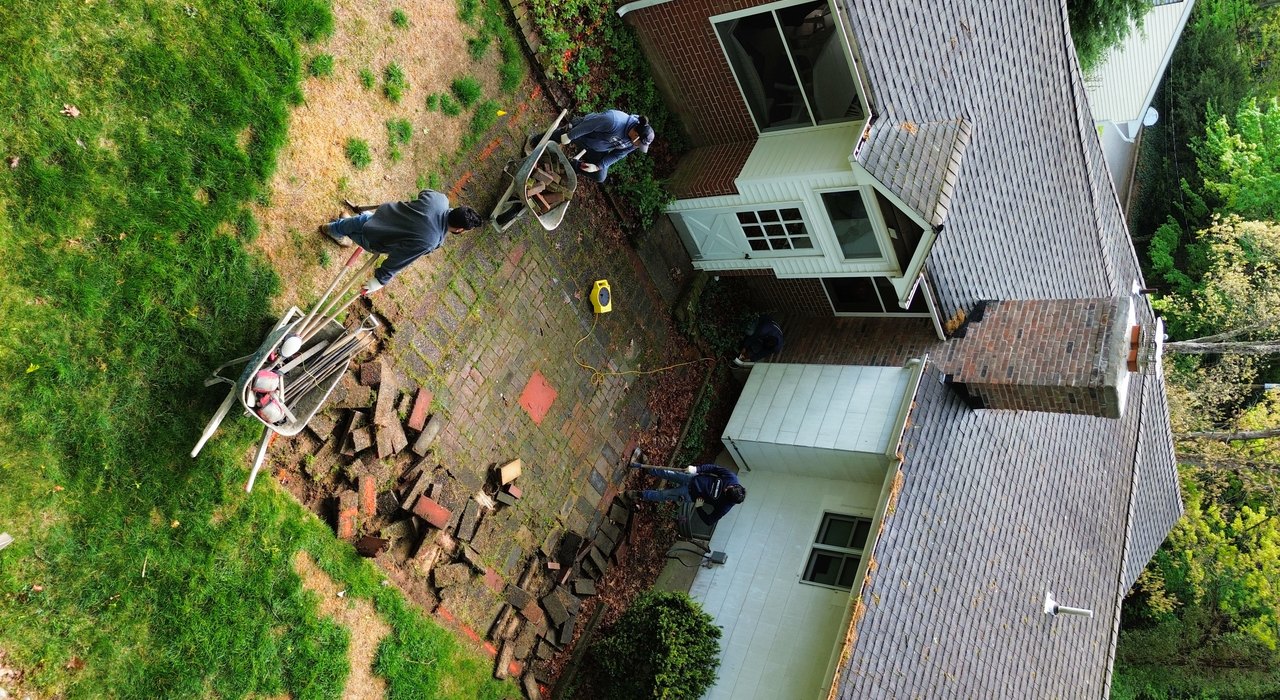
Scope. Lifting and resetting a few units is a short visit. Correcting grade across a wide area means pulling pavers, fixing the base and screeding fresh bedding sand. The square footage of base rebuilt moves the number the most.
Can a heaved patio settle back by itself?
Partly, sometimes, but never reliably. Ice lenses form where susceptible soil, freezing temperatures and water meet, and those conditions vary across a yard, so the surface returns uneven. If an area lifts every winter, drainage and subgrade need work.
Fix the Layer, Not the Symptom
Re-sanding a joint that opened because the edge restraint let go buys you one season. Learn the seven signs above, because each names a layer and the layer names the work. Honest paver patio maintenance keeps several of these signs from ever starting.
Book a paver patio repair Nassau County assessment before the next freeze. Send photos and a few details through our contact page and we will tell you which layer is talking and which published range it falls in.