
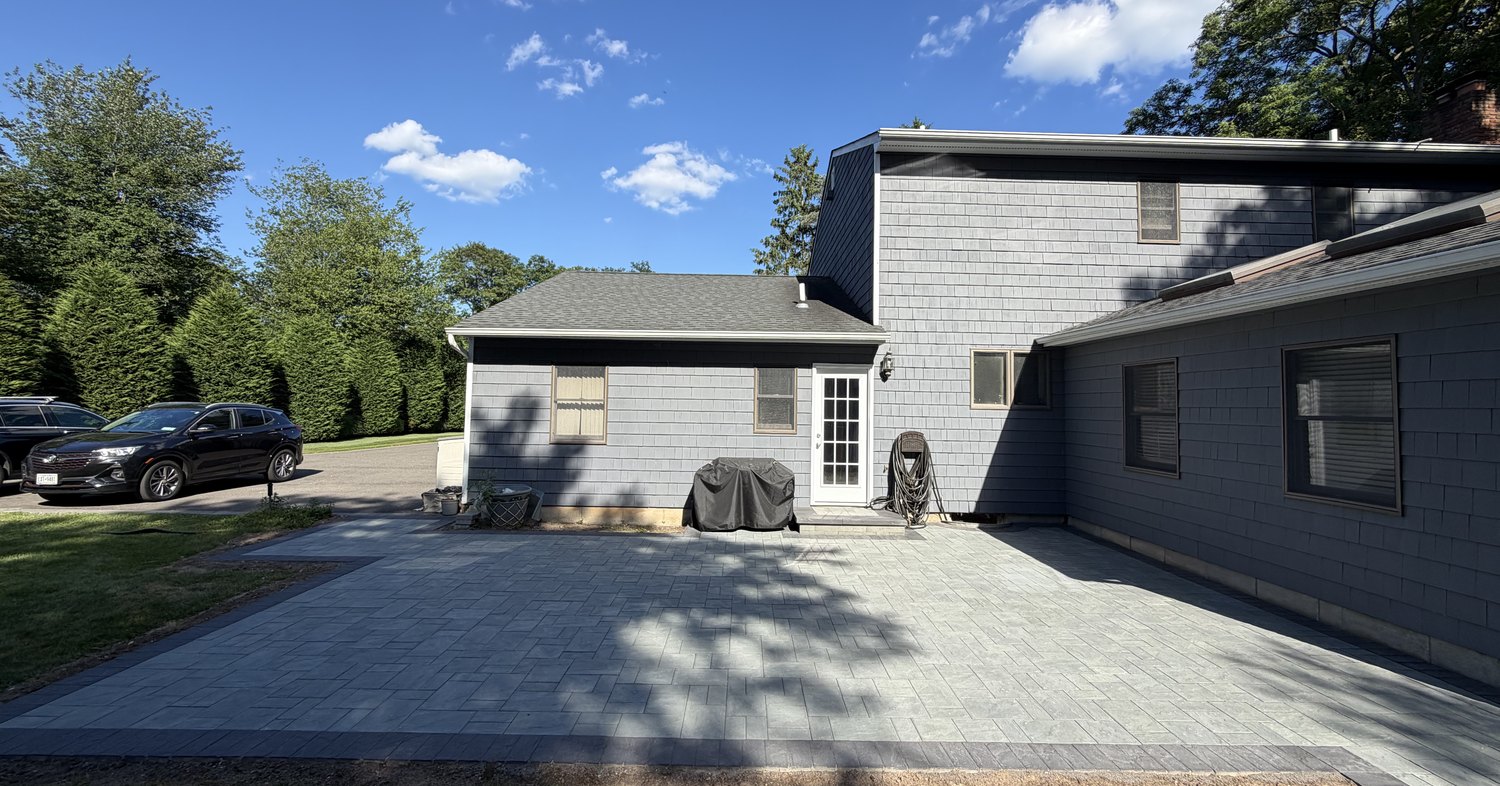
A paver driveway Long Island homeowners can count on starts long before the first paver is set. It starts with the soil under it, the permit governing the apron, and where the water goes. We have built hardscape across Nassau County for over 15 years, and driveways punish shortcuts fastest.
This is not a price post. Our cost breakdown already lives on the site, so this space goes to what makes a job last: the styles that fit local houses, the base underneath, and the curb cut permit your town controls. Price gets one section, and every figure is one we publish.
Quick answer: A paver driveway Long Island homeowners install runs $20 to $55 per square foot, our published range. Plan on six to eight inches of compacted base, a herringbone field, and a curb cut permit before work starts.
Table of Contents
Paver Driveway Long Island Cost: The Ranges We Publish
What driveway pavers cost on your property depends on square footage, material, and what has to come out first. These ranges are the ones our company already publishes, not an industry average we borrowed. Installed, we publish $20 to $55 per square foot. By material that is $28 to $40 for brick, $20 to $32 for concrete pavers, and $35 to $55 for natural stone.
A two car driveway of 18 by 36 feet, roughly 650 square feet, lands between $13,000 and $35,000 installed. Removing the old surface is separate: we publish $1,500 to $4,000 for asphalt and $2,000 to $5,000 for concrete on a standard two car drive. Most driveways here run 300 to 800 square feet, so size moves a paver driveway Long Island quote more than any other choice. Our complete cost guide breaks out each line.
Paver Driveway Long Island Styles That Suit Local Homes
Pattern is not decoration. On a paver driveway Long Island, joint layout is what moves wheel load sideways instead of straight down, so we settle it first. Proportion and color do the rest.
- Herringbone at 45 or 90 degrees. The workhorse field for anything cars drive on, and the pattern CMHA recommends where cars turn and brake.
- Running bond. Calmer and more traditional, well suited to the long narrow drive alongside a colonial.
- Large format field with a contrasting border. Wide, low proportions that read well against a ranch.
- A brick driveway paving band. A soldier course of Class SX clay brick at the edge or across the apron finishes a concrete field, and the warm red suits a Cape Cod.
- Two tone field. Two close colors laid at random keep a large paver driveway Long Island surface from reading flat.
What Goes Underneath a Driveway That Holds Up
CMHA Tech Spec 10 is our reference: a driveway gets six to eight inches of compacted granular base, four to six on a walkway. Bedding sand runs one to one and a half inches, uncompacted and uniform. Compaction hits 98 percent standard Proctor (ASTM D698), and 98 percent modified Proctor (ASTM D1557) where traffic is constant. Joints run one sixteenth to three sixteenths of an inch, with edge restraint mandatory around the perimeter.
Vehicular pavement typically calls for a 3 1/8 inch (80 mm) unit, and the CMHA specification guide sets that as its vehicular minimum. The same Tech Spec 10 still allows 60 mm on residential driveways. Herringbone is a CMHA recommendation for continual vehicular traffic, not code; the guide says to lay per the drawing. We publish our own: 8 to 12 inches of excavation below grade on a paver driveway Long Island, 5 to 7 on a patio.
Materials and the Standards That Govern Them
ASTM C936 governs concrete units: 8,000 psi average strength, no unit below 7,200 psi, average absorption under 5 percent and none above 7, 60 mm minimum thickness, 101 square inches maximum face area, length to thickness ratio under four. The current edition measures freeze thaw by mass loss under ASTM C1645: 225 g/m2 at 28 cycles or 500 g/m2 at 49 cycles, in 3 percent saline where deicers are used.
For brick driveway paving, ASTM C902 covers pedestrian and light traffic and expressly includes residential driveways. Only Class SX belongs on a paver driveway Long Island, where brick can freeze saturated: 8,000 psi average, 8 percent maximum cold water absorption, 0.78 maximum saturation coefficient. Type II is the abrasion class named for residential drives; Type I is tougher. Heavy vehicular brick falls under ASTM C1272. Bluestone specified as quartzitic sandstone holds absorption to 3.0 percent.
| Material | Range | Standard | Class/type | Pattern |
|---|---|---|---|---|
| Concrete pavers | $20 to $32 | ASTM C936 | 8,000 psi, 60 mm | Herringbone |
| Clay brick | $28 to $40 | ASTM C902 | Class SX, Type II | Herringbone, soldier |
| Natural stone | $35 to $55 | ASTM C616 | Quartzitic, 3.0% | Running bond |
Want a working number first? Our Build and Price tool prices a paver driveway Long Island crews would build, using the ranges above.
The Curb Cut Permit Most Long Island Homeowners Miss
Every town regulates the curb cut. Hempstead Chapter 182 bars building or rebuilding a driveway or curb cut on a public street without a permit, filed with a dimensioned plot plan of driveways, curbs and sidewalks, existing and proposed. Coded fees: $55 one car, $75 two cars, $350 commercial, though the Highway Department publishes the current schedule, so confirm them. Penalties reach $250 and 15 days, each day separate.
Hempstead caps the curb cut at 10 feet for one car, 18 for two and 25 commercial, and sets minimums of 25 feet from an intersecting property line on a corner, 24 inches to side lot lines, and 50 feet of frontage for a U drive. North Hempstead Chapter 18 wants its Superintendent of Highways permit and insurance of no less than $1,000,000 combined single limit naming the Town. Oyster Bay Chapter 205, Article III, wants the Commissioner of Public Works, a bond, a deposit, $300,000 to $500,000 injury and $50,000 property coverage.
Searching driveway installation near me returns names; asking who files that permit finds crews who have built a paver driveway Long Island apron.
County Roads and Stormwater Across Nassau County
If your apron meets a county road, the town permit is not the end. A Nassau County Department of Public Works road opening permit applies too; its permits and fees page is where to start. Residential is $735: $275 nonrefundable application plus $460 inspection, a restoration deposit set after plan review, a bond accepted above $25,000, and $1,000,000 insurance per occurrence. Commercial is $1,470.
No published map tells you whether your street is county owned, so call the DPW and your town highway department. North Hempstead section 70-202.2(A) requires two and a half inches of rain held on site once new impervious surface passes 5 percent of the lot area or 750 square feet, whichever is less. Two car drives run 600 to 800 square feet, so most trip it.
Hempstead’s Article XXXVIII calls a driveway impervious but fixes no threshold and no retention depth; its stormwater plan starts at an acre. Section 22’s 25 percent cap covers building area, and the ordinance never says a driveway counts.
Request a Free Driveway Estimate. Searching driveway installation near me? We return estimates in 12 to 24 hours across Nassau County and Long Island, with a three year workmanship warranty. Call (631) 275-3142, 8AM to 5PM Eastern, or write us.
Frequently Asked Questions
What paver thickness does a paver driveway Long Island property need?
Vehicular pavement typically calls for a 3 1/8 inch, or 80 mm, unit, and the CMHA specification guide sets 80 mm as its minimum for vehicular applications. The same Tech Spec 10 still permits 60 mm on residential driveways.
Do I need a permit to widen my driveway apron?
Yes. Hempstead, North Hempstead and Oyster Bay each require a permit before a driveway or curb cut serving a public street is built or rebuilt. The application normally includes a dimensioned plan of existing and proposed driveways, curbs and sidewalks.
Is herringbone required by code?
No. Herringbone at 45 or 90 degrees is a CMHA recommendation for areas of continual vehicular traffic, not a code requirement. The specification guide directs installers to lay units per the project drawing, so pattern stays a design decision.
What do driveway pavers cost per square foot?
Published installed ranges run $20 to $55 per square foot, with concrete units at the low end, clay brick in the middle and natural stone at the top. Removing the existing surface is quoted separately and depends on the material.
How long does an interlocking paver surface last?
CMHA publishes a 20 to 40 year design life, though that figure comes from streets and parking lots rather than homes. No equivalent published number exists for a residential drive, so read it as a durability reference and not a guarantee.
What We Check Before Anyone Signs
Ask every bidder three things. Which town office are you filing the curb cut with, and who pays? What base depth and compaction standard are you holding, and will you put it in writing? What unit thickness are you setting on a paver driveway Long Island, 60 mm or 80 mm? Our published expectation is 25 to 50 years, a separate claim from the CMHA figure.
Ready to price a paver driveway Long Island neighbors will notice? We have completed more than 2,000 patios in over 15 years as a Preferred and Certified Cambridge installer, and estimates are free. Start on our Nassau County driveway page and we will walk the property with you.