
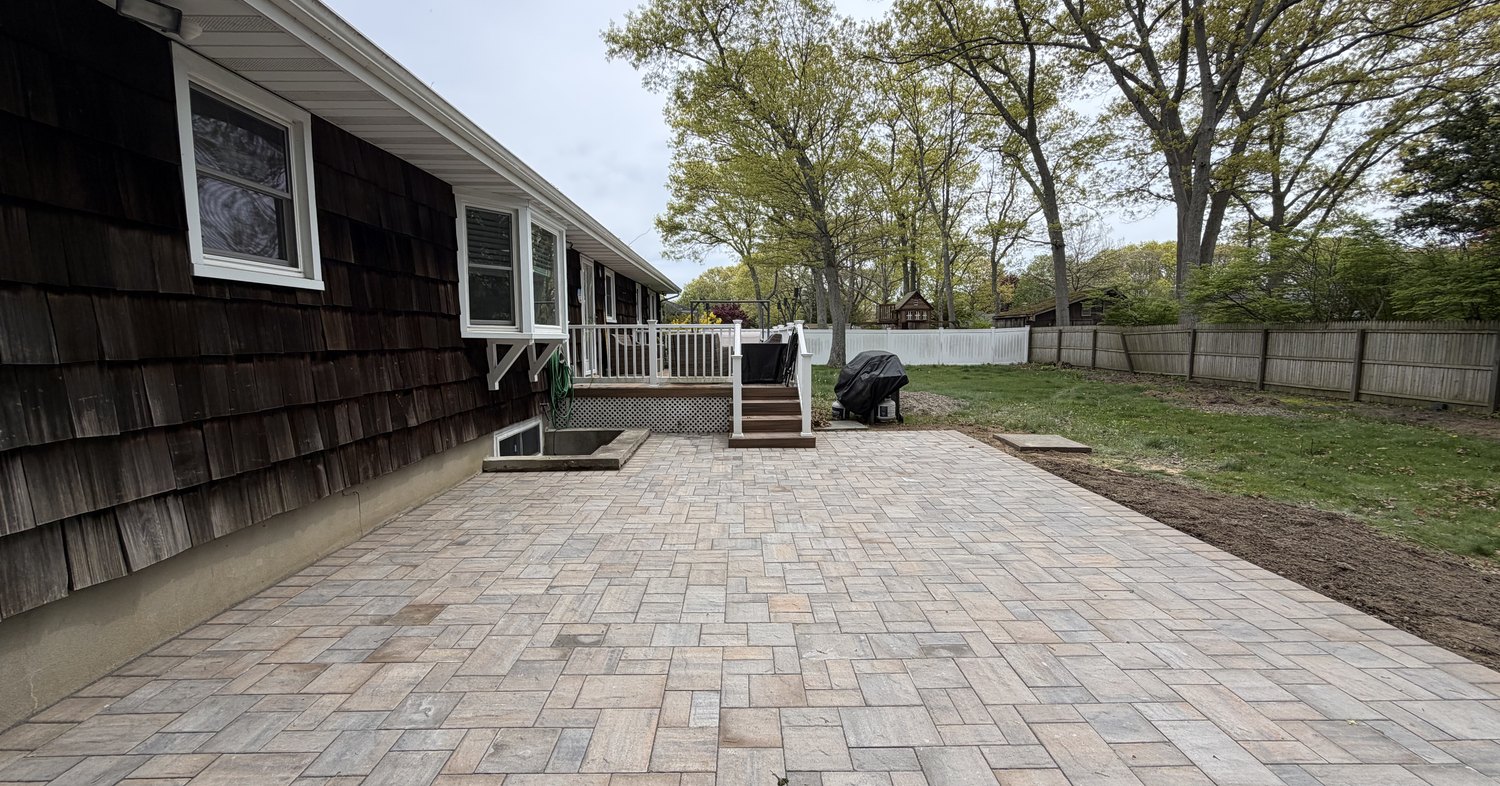
The best material for a patio on Long Island is decided by one thing most guides skip: what the water inside the material does when it freezes. Mineola records a normal January low of 27.2 F, 18.5 inches of snow a year and 45.33 inches of precipitation. That water has to go somewhere.
We have built patios across Nassau County for more than 15 years and finished more than 2,000 of them. Our older post on the best material for a patio is the short general version and compares three options. This one compares five, and every judgement rests on a published standard.
Quick answer: On a freeze thaw site the best material for a patio is the one that lets in the least water. Interlocking pavers under ASTM C936 cap absorption at 5 percent and pass 50 freeze thaw cycles, quartzitic bluestone caps it at 3.0 percent, and clay brick has to be Class SX.
Table of Contents
Why Long Island Freeze Thaw Decides the Best Material for a Patio
The mechanism is plain. Water soaks into the pores of a paving unit, the temperature drops below freezing, and that water expands as it turns to ice. If enough of it sits inside the material, the expansion pushes the surface apart from within, and the face spalls or flakes at the edges first. Every material below loses that argument at a different speed.
Mineola normals give the pattern: a January low of 27.2 F, 2.9 inches of snow in January, 18.5 inches across the year and 45.33 inches of annual precipitation feeding all of it. No single figure there is extreme. Repetition is the problem, because a surface gets wet, freezes, thaws and gets wet again for months. That is why the best material for a patio in Nassau County is chosen on absorption first and appearance second.
Water Absorption Is the Thread Through Any Patio Material Comparison
Less water absorbed means less water inside to freeze and expand. That single idea ties the five materials together, and it is why the standards below open with an absorption limit rather than a strength number.
Interlocking concrete pavers are held to a 5 percent average. Clay brick in the only class that suits this climate may reach 8 percent. Bluestone specified as quartzitic sandstone is capped at 3.0 percent. Poured and stamped concrete are cast on site as one slab, so there is no per unit absorption class to write on an order or check on delivery.
A patio material comparison built on color and joint pattern skips the figure that decides how a surface looks after ten winters. Rank the five on absorption and the best material for a patio stops being a matter of taste.
Interlocking Concrete Pavers and What ASTM C936 Requires
The ASTM C936 specification sets the floor for solid interlocking concrete paving units. A paver that truly meets it clears every line below.
- Average compressive strength of 8,000 psi, no single unit under 7,200 psi.
- Average absorption no greater than 5 percent, no single unit over 7 percent.
- Fifty freeze thaw cycles with no breakage and dry mass loss of 1.0 percent or less.
- Abrasion loss no greater than 15 cubic centimeters per 50 square centimeters.
- Minimum thickness of 60 mm, which is 2.36 inches.
- Tolerances of 1/16 inch on length and width and 1/8 inch on height.
That freeze thaw clause is why a C936 unit is our default answer for the best material for a patio here. It is the only one of the five with a winter test written into the product standard.
Clay Brick and Bluestone: the Stone vs Brick Patio Decision
ASTM C902 sorts clay pavers into three weathering classes. Class SX covers brick that may be frozen while saturated, MX suits places where frost resistance is not a consideration, and NX is protected interior use. On Long Island only Class SX belongs outdoors, a real decision at the counter.
Class SX averages 8,000 psi, absorbs no more than 8 percent in cold water and holds a saturation coefficient of 0.78 or lower. C902 also grades abrasion as Type I, II and III, and Type II is the one for residential walkways and driveways.
Bluestone specified as quartzitic sandstone is the tightest of the five: 3.0 percent absorption, 10,000 psi compression, a 1,000 psi modulus of rupture, 150 pounds per cubic foot density and abrasion resistance of 8. A generic sandstone may be sold at 8 percent absorption, 4,000 psi and abrasion resistance of 2. The stone vs brick patio choice is one of grade.
Poured and Stamped Concrete Through a Long Island Winter
Poured concrete is one continuous surface, and continuous surfaces crack. We will not quote a crack rate, because no published residential figure exists that we would stand behind. What matters is what follows: the crack is permanent, and a fill stays visible.
Stamped concrete is that same slab with a pattern pressed into the top, so it is harder to repair still, since a patch must match texture and color, not just fill a gap. Unit paving fails differently, and that is much of why the best material for a patio here is usually one laid as units. The damaged piece lifts out and a match drops in, the case in our concrete patio versus paver patio comparison.
One caution on lifespan. Interlocking concrete pavement carries a published design life of 20 to 40 years, with analyses run to 50, but that describes vehicular pavement and no equivalent is published for a poured slab.
| Material | Absorption | Strength | Freeze thaw | Repair |
|---|---|---|---|---|
| Concrete pavers, C936 | 5% average, 7% max | 8,000 psi average | 50 cycles, 1.0% loss | Swap the unit |
| Clay brick, C902 SX | 8% cold water | 8,000 psi average | Frozen saturated | Swap the unit |
| Bluestone, quartzitic sandstone | 3.0%, lowest here | 10,000 psi compression | Least water | Reset the piece |
| Poured concrete | None defined | Mix dependent | None published | Cracks are permanent |
| Stamped concrete | None defined | Mix dependent | None published | Patch must match |
Not sure which row fits your yard? Send the dimensions and a photo and we will name the material we would specify. We handle paver patio installation across Nassau County, and estimates come back in 12 to 24 hours.
Matching the Best Material for a Patio to a Nassau County Yard
Standards narrow the field. The yard picks the winner, and four situations cover most of what we see.
- A pool surround or a shaded north side that stays damp: take the lowest absorption available, which points at bluestone or a C936 paver.
- A patio that doubles as a parking apron: strength and abrasion decide, so Type II brick or a C936 paver.
- A large field where a repair is likely one day: units, because the fix is a swap rather than a scar.
- A patio you may extend later: units again, since a slab does not grow cleanly.
Color and joint pattern come after that, never before. The best material for a patio changes with the site far more often than with taste, and we build to the same spec on patios throughout Nassau County, from Mineola to Massapequa.
Want the five compared on your own patio? Tell us where water sits after a storm and how the space gets used, then reach us through our contact page and we will put the right choice in writing.
Frequently Asked Questions
What does ASTM C936 require?
An average compressive strength of 8,000 psi with no unit below 7,200 psi, average absorption of 5 percent with no unit above 7 percent, 50 freeze thaw cycles at 1.0 percent maximum mass loss, and 60 mm thickness.
Why must clay brick be Class SX?
ASTM C902 defines SX as the weathering class for brick that may be frozen while saturated. MX suits places where frost resistance is not a consideration, and NX is interior use only. Class SX caps cold water absorption at 8 percent.
In a stone vs brick patio, which absorbs less?
Bluestone specified as quartzitic sandstone absorbs no more than 3.0 percent, against 8 percent for Class SX clay brick. A generic sandstone can also reach 8 percent, so the grade on the order matters more than the material name.
Do pavers outlast a poured slab?
Interlocking concrete pavement carries a published design life of 20 to 40 years, with analysis periods to 50, but that is a vehicular figure and no equivalent is published for a poured slab. The measurable difference is repairability.
Does stamped concrete crack in winter?
Poured slabs crack, and stamped concrete is a poured slab with a pattern pressed into it. The crack is permanent once it forms, and the pattern makes a repair harder to hide, since a patch must match texture and color.
What the Best Material for a Patio Comes Down To
Five materials, one test. Ask how much water each lets in, then ask what happens when a piece has to come out. Bluestone at 3.0 percent, a C936 paver at 5 percent and Class SX brick at 8 percent all hold up on Long Island, so the best material for a patio is whichever your site argues for.
We are a Preferred and Certified Cambridge installer, we back our labor with a 3 year workmanship warranty, and our Build and Price tool gives a number before anyone visits.
Let us specify it once and build it once. Call (631) 275-3142 between 8AM and 5PM Eastern and we will read the drainage and name the best material for a patio on your Nassau County lot.