
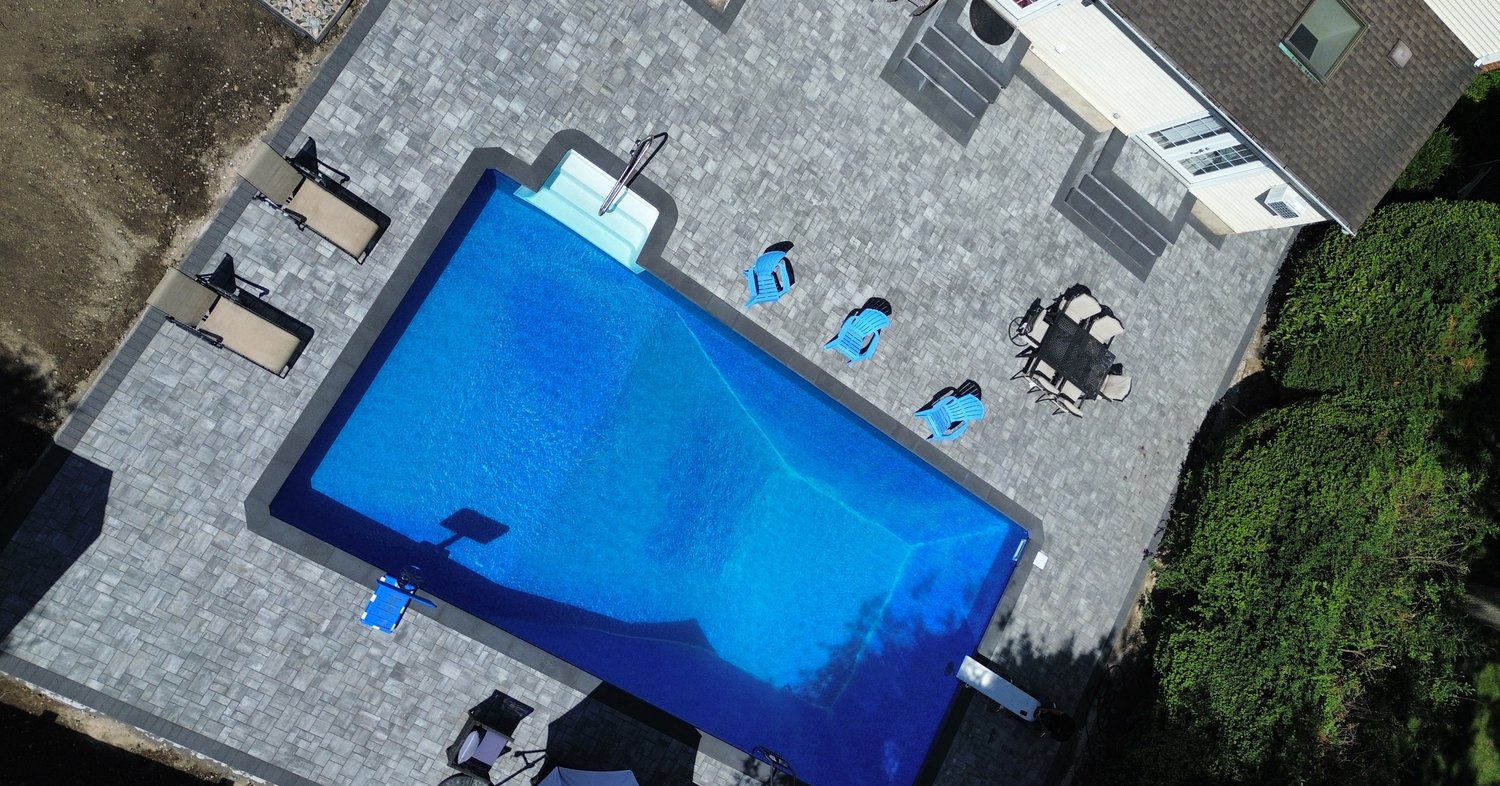
Pool patio pavers Nassau County homeowners live with come down to three measurable things: how much water the material absorbs, how it behaves wet under a bare foot, and how much heat it holds in the sun. Style comes fourth, and it gets easier once the first three are settled.
We have built patios on Long Island for more than 15 years and finished more than 2,000 of them. We install the patio around your pool, not the pool. Below are five options for pool patio pavers Nassau County suppliers stock, measured against ASTM, CMHA and the New York Residential Code.
Quick answer: The best pool patio pavers Nassau County yards can hold combine low absorption, a declared Exterior Wet rating and a light color. Concrete caps absorption at 5 percent, Class SX brick at 8, bluestone at 3.0. Five pool paver ideas follow.
Table of Contents
Choosing Pool Patio Pavers Nassau County Winters Will Not Break
Freeze damage starts with absorbed water. Concrete pavers under ASTM C936 average no more than 5 percent absorption, no unit above 7 percent, and reach 8,000 psi average strength, no unit below 7,200 psi. Minimum thickness is 60 mm. Freeze-thaw now runs under ASTM C1645: 225 g/m2 at 28 cycles or 500 g/m2 at 49, in 3 percent saline where deicers are used.
Clay brick under ASTM C902 has three weathering classes. Only Class SX belongs on Long Island, rated for brick that can freeze saturated, capping cold water absorption at 8 percent with a saturation coefficient no higher than 0.78.
Bluestone graded as quartzitic sandstone under ASTM C616 absorbs no more than 3.0 percent, tightest of the five. Pool patio pavers Nassau County crews set in May meet their test in January, when Mineola’s normal low is 27.2 degrees F.
Five Pool Paver Ideas Compared, Option by Option
These are the five pool patio pavers Nassau County yards use most, each strong for a reason.
- Standard 60 mm concrete paver: the C936 minimum thickness, widest color range, easiest to reset.
- Textured or tumbled concrete paver: the same C936 numbers with a broken-in face underfoot.
- Large format concrete slab: fewer joints, a calmer look, heavier units to carry.
- ASTM C902 Class SX clay brick: color running through the body, so wear never shows.
- Bluestone at quartzitic sandstone grade: 3.0 percent absorption, 10,000 psi, 1,000 psi modulus of rupture.
Common sandstone is the trap. It allows up to 8 percent absorption, 4,000 psi compression, a modulus of 350 psi and abrasion 2 against 8. Ask for the grade, not the word bluestone. Our guide to the best material for a patio compares the same families.
Slip Resistance: What ANSI A326.3 Really Says About Wet Decks
ANSI A326.3, 2022 edition, measures dynamic coefficient of friction wet. Its classifications are Interior Dry, Interior Wet, Interior Wet Plus, Exterior Wet and Oils/Greases. The standard’s only numeric minimum is 0.42, and it belongs to Interior Wet. For Exterior Wet there is no number, only Manufacturer-Declared.
You will hear 0.50 and 0.55 quoted around pools. Those are trade convention, not requirements, and no code demands them. For pool decks the standard provides no single limiting DCOF value, since drainage, texture and contaminants change it.
Among pool patio pavers Nassau County suppliers carry, the best pavers for pool decks are the ones whose maker declares an Exterior Wet class in writing. ASTM C1028, the static test, was withdrawn April 14, 2014 with no replacement. A supplier quoting 0.60 static cites a dead standard.
Heat, Color and Salt Water Around an Inground Pool
Nobody publishes a surface temperature for light concrete pavers against dark ones, so we will not invent one. The Heat Island Group at Lawrence Berkeley National Laboratory measured light pavement close to 30 degrees F cooler than dark. For pavers around inground pool decks, lighter color wins.
Albedo backs it up. New gray cement concrete pavement reads 0.35 to 0.40, aging to 0.20 to 0.30. White cement concrete reads 0.70 to 0.80 new, 0.40 to 0.60 aged. New asphalt sits at 0.05 to 0.10, and those are pavements, not pavers.
Salt water is a fair question. CMHA reports no reaction between salt and the pigmenting oxides in a quality paver, and white deposits are evaporated moisture a warm rinse removes. Salt plus freeze and thaw accelerates concrete deterioration, and acids permanently change color on pool patio pavers Nassau County decks.
Installing Pool Patio Pavers Nassau County Homeowners Keep
CMHA Tech Spec 10 is our reference for pool patio pavers Nassau County. Around pools a concrete base of at least 4 inches is typically used where fill or granular base will not compact, and over an impervious base may require 2 inch diameter vertical weep holes at low points. Cross slope is at least 2 percent.
Bedding sand goes down 1 to 1 1/2 inches uncompacted at constant thickness, and edge restraint runs the full perimeter. That is not optional on pavers around inground pool edges, where the outside course leans on nothing. Same system as every paver patio installation.
Coping has no standard. Unilock specifies roughly a 2 inch overhang past the pool edge, 1/4 inch joints and 2 percent slope away from the water. Anyone quoting a required coping thickness guesses. Our pool patio installation work starts there.
| Option | Absorption | Wet, barefoot | Heat by color | Repair |
|---|---|---|---|---|
| 60 mm concrete paver | 5% average, 7% max | Declared Exterior Wet | Lighter runs cooler | Reset one unit |
| Tumbled concrete paver | 5% average, 7% max | Ask for the declared class | Lighter runs cooler | Reset one unit |
| Large format slab | 5% average, 7% max | Ask for the declared class | Lighter runs cooler | Heavier to reset |
| Clay brick, Class SX | 8% cold water, 0.78 sat | Ask for the declared class | Reds read warm | Unit for unit |
| Quartzitic bluestone | 3.0% maximum | Ask for the declared class | Darker tones absorb more | Match by hand |
Not sure which line fits your deck? Send a photo of the pool and coping and we will match the pool patio pavers Nassau County suppliers carry to your sun and slope. Free estimates in 12 to 24 hours.
Setbacks, Pool Barriers and Alarms on Long Island
Setbacks are not a county rule; each town writes its own. Hempstead keeps a rear yard pool 4 feet off rear and side lines, 10 feet off a street line on a corner lot, and under 40 percent of that yard. North Hempstead keeps an inground pool at least 10 feet off rear and side lot lines, or the stricter district side setback.
Oyster Bay allows no part of the pool closer than 5 feet to a lot line or the accessory setback, whichever is greater, and a fence of 4 to 6 feet must stand at least 5 feet from the pool edge. Overflow may not drain onto a neighbor. We work across Nassau County, where towns and villages issue permits.
R326 sets the barrier at a minimum of 48 inches above grade, a gap beneath no wider than 2 inches, and no opening passing a 4 inch sphere. R326.7 adds an ASTM F2208 alarm on pools built or substantially modified after December 14, 2006. New York’s pool code summary collects what pool patio pavers Nassau County work touches.
Ready to plan the deck around your pool? Ask for an on-site look and we will bring declared Exterior Wet ratings and the best pavers for pool decks in your range. Our Long Island work carries a 3 year workmanship warranty.
Frequently Asked Questions
Is there a required DCOF number for a pool deck?
No. ANSI A326.3 sets 0.42 only for Interior Wet and lists Exterior Wet as Manufacturer-Declared. The standard states that no single limiting value is provided for pool decks, since drainage, texture and contaminants change the result on site.
Which are the best pavers for pool decks on Long Island?
Judge by absorption first. Bluestone at quartzitic sandstone grade caps at 3.0 percent under ASTM C616. Concrete pavers average 5 percent under ASTM C936, no unit over 7. Class SX clay brick allows 8 percent cold water absorption.
Do pavers around inground pool decks need edge restraint?
Yes. Edge restraint runs the full perimeter of any flexible paver pavement, and the outside course of a pool deck has nothing else holding it. CMHA also calls for at least 2 percent cross slope and uncompacted bedding sand.
How often should a pool patio be sealed?
Unilock publishes no more than one application every three years, and two applications in total. Excess sealer builds a film that discolors under sun. That is a manufacturer instruction rather than a code rule, so follow the product used.
Does a private backyard pool need a 5 foot deck?
Not under the state health rule. The continuous 5 foot deck sloped 1/4 inch per foot comes from 10 NYCRR 6-1.29, which governs public pools, and 6-1.3(a) expressly excludes the private one-family pool. It stays a sound design reference for walking room.
Getting the Edge Right the First Time
Order of operations settles most pool paver ideas. Confirm the town setback and the barrier, then choose by absorption, then by declared Exterior Wet class, then color, then looks. Run that list backwards and the deck gets built twice.
North Hempstead adds a step nobody mentions. Where construction exceeds 5 percent of the lot area or 750 square feet, whichever is less, 2 1/2 inches of rain must be held on site. A wide pool deck gets there fast, so good pool patio pavers Nassau County work plans ahead.
Get a free pool patio estimate. Call (631) 275-3142, 8AM to 5PM Eastern, or reach us through our contact page, and we will spec the pool patio pavers Nassau County weather rewards, around your own pool.