
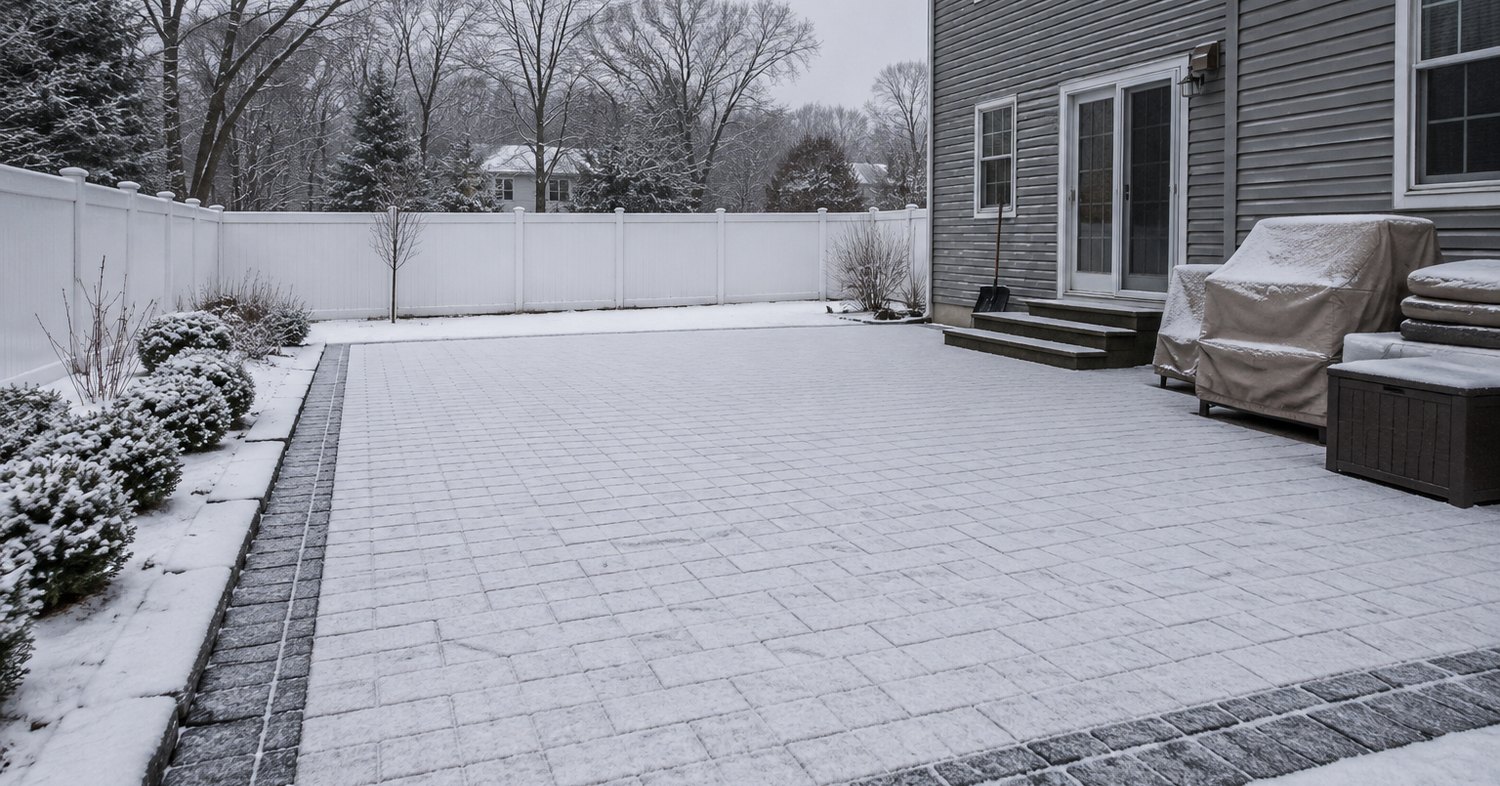
Winter patio protection on Long Island is a water problem before it is a cold problem. Ice cannot lift a stone that has nowhere to hold water, and a base that drains does not heave. Nearly every settled patio we repair in March traces back to water that sat where it should not have.
This guide is the mechanism, not the calendar. We explain what a freeze thaw cycle does to each layer of a paver system, what absorption and the ASTM C1645 test measure, and why base depth and compaction decide how a patio comes out of February. Real winter patio protection is built in.
Quick answer: Winter patio protection is decided by absorption, drainage and compaction. ASTM C936 caps average absorption at 5% and sets average strength at 8,000 psi, and ASTM C1645 limits mass loss to 225 grams per square meter at 28 cycles. Under the stones, 4 inches of compacted base, 1 inch of bedding sand and 98% Proctor compaction carry the winter.
Table of Contents
Winter Patio Protection Starts With Water, Not Cold Air
A freeze thaw cycle needs three things: water, somewhere to hold it, and a temperature that crosses the freezing point. Cold alone does nothing to a dry, well drained pavement. Water that has soaked into a joint, a setting bed or a base expands as it freezes, and it pushes against whatever surrounds it.
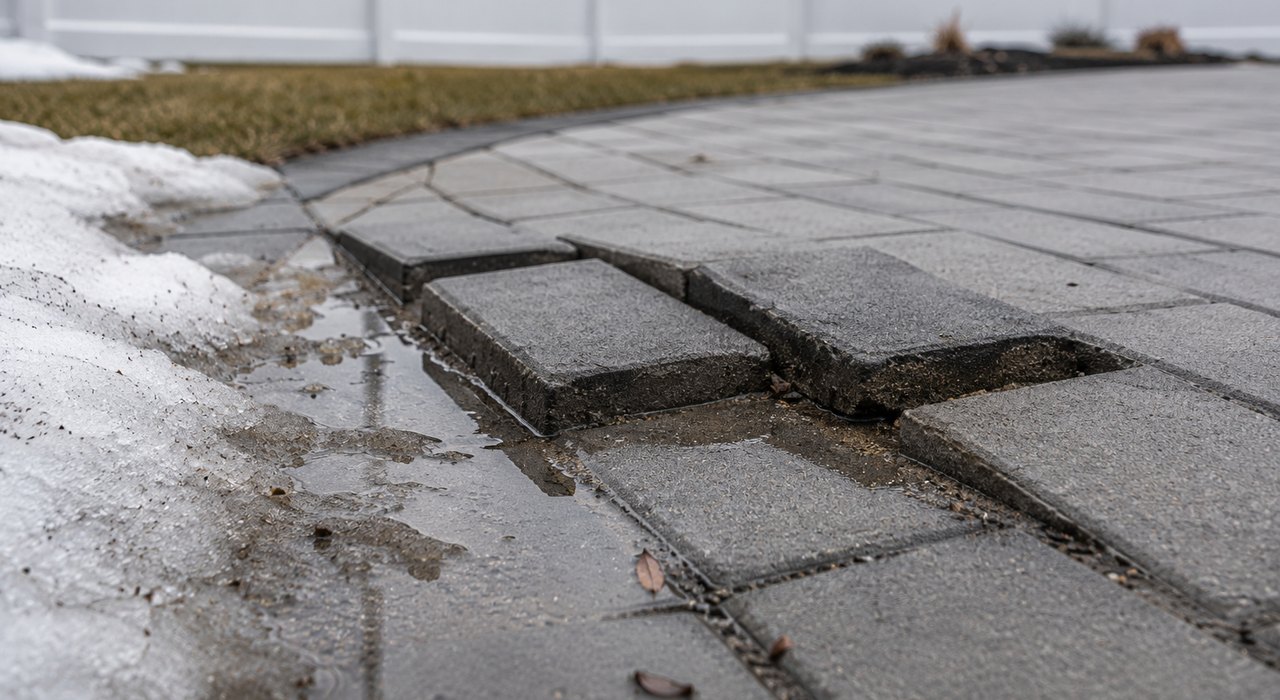
That is why freeze thaw damage rarely begins at the surface. It begins wherever the pavement stores water. An open joint stores it, a bedding layer used to bury a low spot stores it, and a shallow base over wet soil stores the most. Each thaw lets more water in, and the next freeze uses it.
So winter patio protection is not about keeping a patio warm. It is about giving water somewhere to go before the temperature drops, and about density in the layers that cannot drain.
What a Long Island Winter Actually Delivers
NOAA normals for the Islip MacArthur station put the January low at 24.6 F against a January high of 39.2 F, with an annual mean of 53.1 F. That pairing matters more than either figure alone, because a surface that thaws by afternoon and refreezes overnight is running cycles.
Then add the water. Long Island normals show 45.99 inches of precipitation and 31.8 inches of snow a year, 10.3 inches of it in January and 9.4 in February. Snow is water waiting on the surface for the next mild day.
The shoreline is gentler than inland New York on one count. Research published in the Journal of Applied Meteorology and Climatology puts the Long Island coast at fewer than 50 freeze thaw days a year. That is a moderate count, and it still finds every weak layer winter patio protection should have covered.
Absorption and What the ASTM C1645 Test Measures
A concrete paver is not solid. It holds a measurable amount of water, and that percentage decides whether the unit itself suffers. ASTM C936 caps average absorption at 5% and requires an average compressive strength of at least 8,000 psi. Less water inside the stone means less to freeze inside the stone.
Durability is proven separately under ASTM C1645, a cycling test that measures mass lost from the surface. The limits are 225 grams per square meter after 28 cycles, or 500 grams per square meter after 49 cycles, run in water. How much de icing salt pavers can tolerate is tested differently, in a 3% saline solution.
That second version is the technical reason salt matters, rather than an opinion. Salt changes the test, so it changes the exposure. Winter patio protection starts on a product sheet, before anyone excavates.
How Freeze Thaw Damage Moves Through Each Layer
A paver patio is six layers working together, and the cycle attacks each one differently. Read the failure and you can usually name the layer that let water in.
- Units with high absorption lose surface mass cycle after cycle, which ASTM C1645 quantifies.
- Empty joints take on water, freeze, and let individual stones rock loose from the field.
- A bedding layer thicker than 1 inch holds water and lifts the stones above it.
- A saturated base loses bearing capacity, so the surface settles or heaves.
- Wet, weak subgrade moves under everything and carries the base with it.
- A loose edge lets the field creep, and every joint opens wider.
None of this shows up in December. It shows up in March as a low corner, a lipped stone or a drifted seam, so winter patio protection is judged in spring.
| Layer | What the cycle does | Verified specification |
|---|---|---|
| Paver unit | Absorbed water freezes inside and takes mass | ASTM C936: 5% absorption, 8,000 psi |
| Joint sand | Open joints fill with water and freeze | Joints kept full so interlock holds |
| Bedding sand | Deep bedding holds water and lifts stones | 1 inch nominal, uncompacted, screeded flat |
| Aggregate base | Saturation costs bearing capacity, so grade moves | 4 inches on a patio, 6 to 10 on driveways |
| Subgrade | Wet soil holds water under the base | 98% standard Proctor, modified under vehicles |
| Edge restraint | Unrestrained field creeps and joints widen | Secured along every open edge |
Want winter patio protection built in? Send the dimensions and tell us what the yard does after heavy rain. Start on our paver patio page or call (631) 275-3142.
Base Depth and Compaction Decide Winter Patio Protection
ICPI Tech Spec 2 sets the pedestrian patio minimum at 4 inches of compacted aggregate base. A residential driveway over well drained soil needs 6 inches, and in cold climates with wet or weak soil another 2 to 4 inches goes in, for 8 to 10 total. Plenty of Suffolk County yards sit in that second group.
Depth without density is half a job. Residential work is compacted to 98% standard Proctor, vehicular pavement to 98% modified Proctor. A loose lift has voids, voids hold water, and held water freezes. Compaction is invisible and it decides more than any other step whether a patio moves.
Bedding sand stays at 1 inch nominal and uncompacted. Using it to correct a dip leaves a wet pocket under the surface. Our guide to paver base options in Suffolk County covers the materials behind these numbers.
Warranty Limits, Salt and the Seasonal Routine
Manufacturer coverage has edges worth knowing well before the first freeze arrives. The Cambridge limited lifetime warranty is transferable with valid proof of purchase and covers replacement of defective product installed to CMHA guidelines, not the labor to replace it. It expressly excludes efflorescence and damage caused by snow removal equipment.
That exclusion moves real risk to the homeowner. Snow removal on pavers is nobody else’s liability once a blade gouges the surface, and no laboratory cycle accounts for it. The de icing salt pavers see over a season falls in the same category: it is exposure the owner chooses and controls, not a manufacturing defect.
The seasonal routine belongs beside the mechanism. Our winter patio care guide for Long Island is the calendar of what to do and when, and this article is the reason each of those steps works.
Not sure what your patio is sitting on? We have 15 years and more than 2,000 completed patios behind us across Suffolk County and Nassau County. Reach us through our contact page.
Frequently Asked Questions
What actually causes freeze thaw damage in a paver patio?
Water held in the joints, the bedding layer or a saturated base expands when it freezes and pushes the layers apart. The unit itself rarely fails first. Failure starts wherever the pavement was able to store water through a thaw.
What absorption rate should a concrete paver have?
ASTM C936 sets a maximum average absorption of 5% along with a minimum average compressive strength of 8,000 psi. Lower absorption means less water inside the unit to freeze, which is the property governing how it survives repeated cycles.
How is freeze thaw durability tested?
ASTM C1645 cycles samples and measures mass lost from the surface. The limits are 225 grams per square meter after 28 cycles or 500 after 49 cycles in water. Salt exposure is tested in a 3% saline solution instead.
How many freeze thaw days does the Long Island coast get?
Published climatology puts the Long Island shoreline at fewer than 50 freeze thaw days a year, a moderate figure for the Northeast. NOAA normals show a January low of 24.6 F and a high of 39.2 F, so crossings are frequent.
Do paver warranties cover plow and shovel damage?
Manufacturer warranties commonly exclude damage caused by snow removal equipment, and efflorescence is usually excluded as well. Snow removal on pavers is therefore treated as an owner responsibility rather than a product defect, whatever tool the homeowner ends up using.
Winter Patio Protection That Shows Up in Spring
Every point above reduces to one habit: keep water out of the layers that cannot take it. Specify units meeting ASTM C936, hold the bedding sand at 1 inch, build the base to depth, compact to 98% Proctor and keep the joints full.
Fewer than 50 cycles a year is a climate a patio lives through. Skip one and the same winter finds it, which is why every winter patio care step on the calendar matters.
Let us build winter patio protection in from the first lift. We serve Huntington, Smithtown, Islip and the rest of Suffolk County on Long Island, with free estimates in 12 to 24 hours. Call (631) 275-3142 and we will measure.