
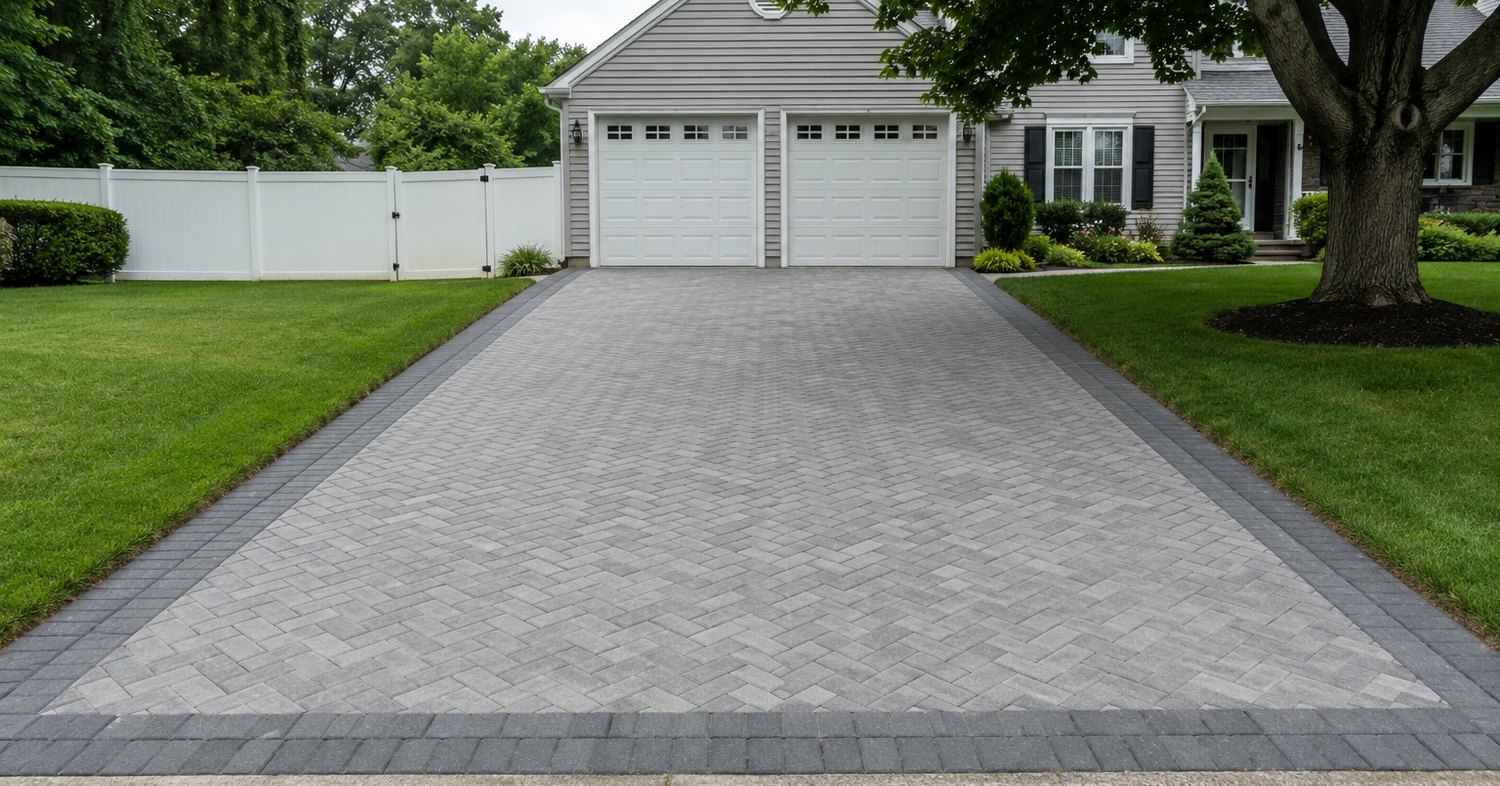
A paver driveway lifespan on Long Island runs 20 to 40 years, and the range is that wide because nearly all of it is decided below the surface. The stones matter far less than the base under them, the compaction behind them and the water moving through them every winter.
We install driveways across Suffolk County and Nassau County, and after 15 years and over 2,000 completed projects we know which details buy years and which quietly cost them. This guide covers the standards behind a long paver driveway lifespan, the winter numbers that test it, and what each warranty pays for.
Quick answer: A paver driveway lifespan of 20 to 40 years is the published design life for interlocking concrete pavement, and CMHA models cost over a 50 year horizon. Getting there takes 6 inches of compacted base on well drained soil, 8 to 10 inches on wet or weak soil, units at least 2-3/8 inches thick, and 98% modified Proctor compaction.
Table of Contents
What a Paver Driveway Lifespan Actually Measures
Interlocking concrete pavement has a design life of 20 to 40 years, and the CMHA life cycle cost analysis models it across a 50 year horizon. That figure covers the pavement system, not one stone. A paver driveway lifespan ends when the surface stops holding grade, not when a single unit chips.
How long do pavers last in real installations? King William Road in Adelaide went in during 1985 and was still in service at 20 years with another 20 projected. The City of North Bay in Ontario laid its pavement in 1983, and it remained in good condition at 39 years. Neither address is on Long Island, yet both were built on the same base and compaction logic we use here. Our comparison of paver driveway versus blacktop and concrete lines the three up.
How Long Island Winters Load a Driveway
NOAA normals for Islip MacArthur put the January low at 24.6 F and the January high at 39.2 F, against an annual mean of 53.1 F. That hovers near the freezing point for weeks. Add 45.99 inches of precipitation and 31.8 inches of snow a year, 10.3 inches of it in January, and every joint spends the season wet.
The coast is gentler than inland New York on one measure, since the Long Island shoreline sees fewer than 50 freeze thaw days a year. Those days still shape a paver driveway lifespan, because each one works on the water the pavement holds. The freeze thaw damage pavers suffer begins with saturation, so winter punishes drainage mistakes.
- Water trapped in a soft or under compacted base, which then heaves
- Deicing salt sitting in open joints where the sand has washed out
- Plow and shovel blades catching a lippy edge or a loose restraint
The Base and Compaction Behind Driveway Paver Durability
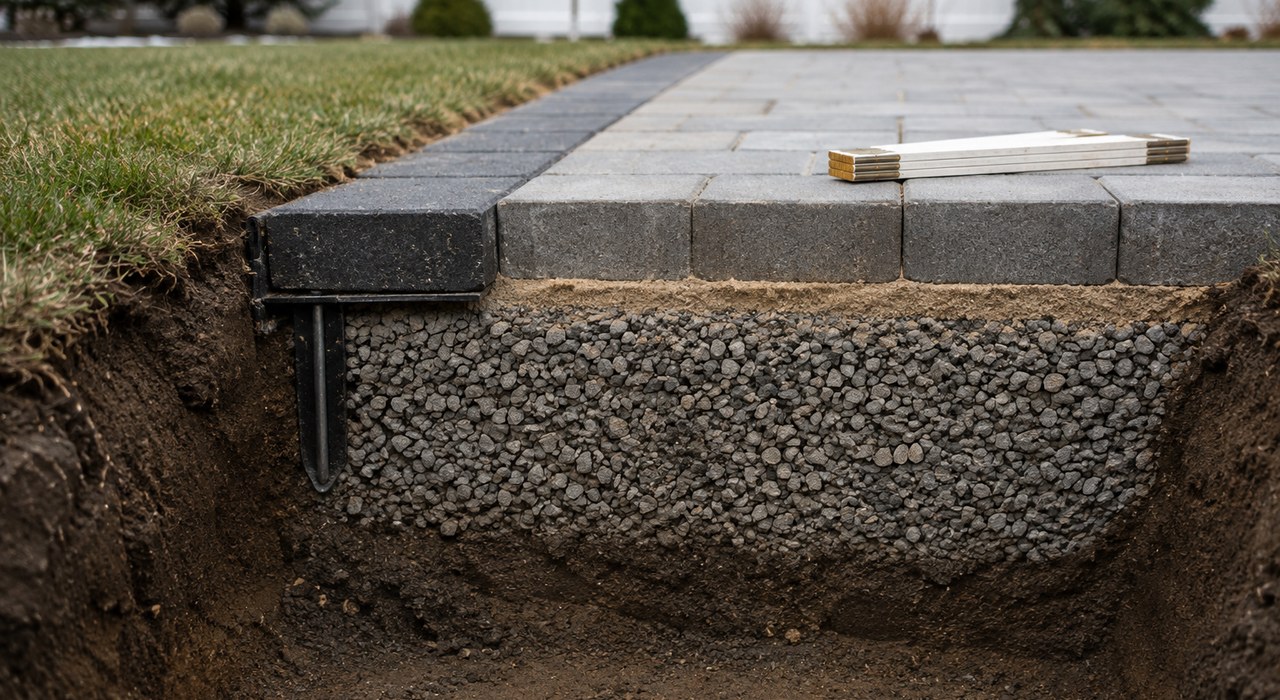
ICPI Tech Spec 2 sets the residential driveway minimum at 6 inches of compacted aggregate base over well drained soil. In cold climates with wet or weak soil, which describes plenty of yards in Suffolk County, another 2 to 4 inches goes in for a total of 8 to 10 inches. A patio needs only 4 inches, so a driveway built to patio spec is short from day one.
Above the base sits 1 inch of nominal uncompacted bedding sand, screeded flat and never used to bury a low spot. Compaction is the other half of driveway paver durability. Residential work is compacted to 98% standard Proctor, while vehicular pavement gets the denser 98% modified Proctor. That is where a paver driveway lifespan is won, and our guide to installing a paver driveway on Long Island walks the sequence.
Strength, Absorption and Freeze Thaw Testing
ASTM C936 is the specification a concrete paver has to meet. It calls for an average compressive strength of at least 8,000 psi and average absorption no higher than 5%. Thickness is written in too: 2-3/8 inches, or 60 mm, is the minimum for pedestrian areas and residential driveways, while 3-1/8 inches, or 80 mm, is the spec for streets.
Durability against cold is tested under ASTM C1645, which caps mass loss at 225 grams per square meter after 28 cycles, or 500 grams per square meter after 49 cycles, in water. For deicing salt the sample runs in a 3% saline solution instead. The freeze thaw damage pavers absorb in that lab is harsher than a Suffolk County winter, so driveway paver durability is worth verifying on the product sheet.
Six Factors That Set Your Paver Driveway Lifespan
Ask a crew what decides a paver driveway lifespan and the honest answer is six things, five of them buried before you ever park on the surface. The stones are the visible factor and the least likely to fail, since a unit meeting ASTM C936 normally outlasts the base under it.
Edge restraint and joint sand are the two most often trimmed from a thin bid. How long do pavers last once turning tires and a plow arrive? Only as long as the field stays locked, and a loose edge lets it creep while empty joints end the interlock.
| Factor | Verified specification | Effect on service years |
|---|---|---|
| Compacted base | 6 inches on well drained soil, 8 to 10 inches on wet soil | A thin base settles and regrading arrives decades early |
| Paver thickness | 2-3/8 inches, or 60 mm, on a residential driveway | Pedestrian thickness under a car cracks units |
| Compaction | 98% modified Proctor for vehicular pavement | Loose lifts consolidate under traffic and rut |
| Drainage | Surface and base water routed off the drive | A saturated base heaves in freezing weather |
| Edge restraint | Secured along every open edge | The field creeps and joints open without it |
| Joint sand | Joints kept full and refilled after washout | Empty joints kill interlock, and units rock |
Want a paver driveway lifespan you can plan around? Send the square footage and tell us what the soil does after heavy rain, and we will spec the base honestly. Call (631) 275-3142 or start on our paver driveway page.
What a Driveway Paver Warranty Covers in Suffolk County
A driveway paver warranty is two separate documents, and mixing them up is how homeowners end up surprised. Cambridge offers a limited lifetime warranty, fully transferable with valid proof of purchase, covering replacement of defective product installed to CMHA guidelines. It does not include replacement labor, and Cambridge limits its liability to the cost of the product.
The exclusions matter just as much: efflorescence, natural staining and environmental dirt, color variation in natural materials, pyrite deposits, polymeric sand haze, and damage from snow removal equipment. Natural stone carries no warranty. Ours is the second document, a 3 year workmanship warranty on the installation, and we hand you both. Suffolk County also requires a home improvement license under Suffolk County Code 563-17(A), issued by the Department of Labor, Licensing and Consumer Affairs at (631) 853-4600.
Not sure what your paperwork covers? Send us the last driveway quote you received and we will read the warranty language line by line with you. Free estimates anywhere on Long Island come back in 12 to 24 hours. Reach us through our contact page.
Frequently Asked Questions
How long do pavers last on a residential driveway?
Interlocking concrete pavement is designed for 20 to 40 years of service, and its cost analysis is modeled over a 50 year horizon. Installations from 1983 and 1985 still performed well at 39 and 20 years, so the upper end of that paver driveway lifespan is realistic.
Does road salt shorten the life of a paver driveway?
Units tested for deicing salt exposure run in a 3% saline solution rather than plain water, and ASTM C1645 caps mass loss at 225 grams per square meter over 28 cycles. Salt is harder on open joints and a wet base than on the units.
How thick should driveway pavers be?
ASTM C936 sets a minimum of 2-3/8 inches, or 60 mm, for pedestrian areas and residential driveways. Streets and other vehicular pavements move up to 3-1/8 inches, or 80 mm. Thickness pairs with base depth, since neither covers for the other.
How deep should the base be in a cold climate?
A residential driveway over well drained soil needs at least 6 inches of compacted aggregate base. In cold climates with wet or weak soil, 2 to 4 more inches are recommended, giving 8 to 10 inches under the bedding sand.
What does a limited lifetime paver warranty actually cover?
That kind of driveway paver warranty typically covers replacement of the defective product when it was installed to the manufacturer guidelines, and stops there. Replacement labor, efflorescence, staining, polymeric sand haze and damage from snow removal equipment are commonly excluded.
Getting the Full Paver Driveway Lifespan on Long Island
A long paver driveway lifespan is not luck. It is 6 to 10 inches of properly compacted base, units meeting ASTM C936 at 2-3/8 inches or thicker, a restrained edge, full joints, and water that leaves the surface instead of standing in it. Get those right and 20 to 40 years is fair.
Planning the budget is the other half. Our driveway paver cost guide for Long Island covers what moves a quote, and the Build and Price tool gives an instant range before anyone visits.
Let us build it once and build it right. We serve Huntington, Smithtown, Islip, Babylon and the rest of Suffolk County and Nassau County on Long Island, New York, with free estimates in 12 to 24 hours and financing available. Call (631) 275-3142 and we will measure this week.