
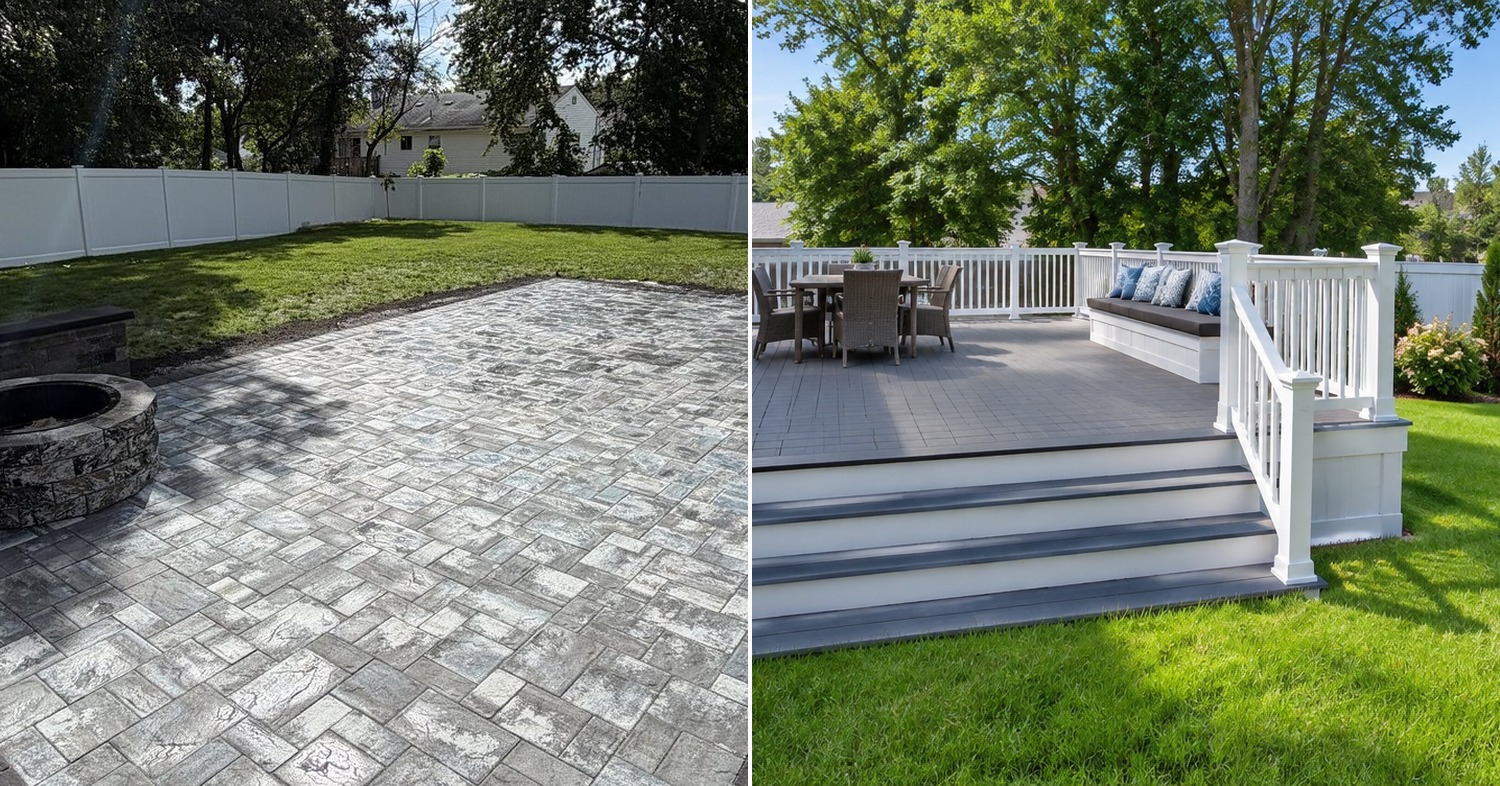
Deciding between a paver patio and deck for your backyard is one of the biggest outdoor living choices a Long Island homeowner faces. Both options create usable outdoor space, but they differ in cost, lifespan, maintenance requirements, and how well they handle the Northeast climate. The right choice depends on your yard, your budget, and how much time you want to spend on upkeep over the next 20 to 30 years.
This guide compares every angle of the paver patio and deck decision for Long Island homeowners. We cover deck vs patio cost, deck maintenance vs paver maintenance, structural differences between a raised deck vs ground level patio, and which option delivers the best return on your investment. Affordable Patio has installed over 2,000 outdoor projects across Suffolk County and Nassau County, and we have seen firsthand what works and what fails in this climate.
Quick answer: A paver patio costs $10 to $25 per square foot installed and lasts 30 to 50 years with almost no maintenance. A wood deck costs $15 to $35 per square foot and lasts 15 to 25 years with annual staining and sealing. A composite deck costs $25 to $60 per square foot and lasts 25 to 30 years. For most Long Island backyards, a paver patio and deck comparison favors the patio on total cost of ownership. Call Affordable Patio at (631) 275-3142 for a free estimate.
Table of Contents
- Deck vs Patio Cost on Long Island
- Lifespan and Durability Differences
- Deck Maintenance vs Paver Maintenance
- Raised Deck vs Ground Level Patio
- How Long Island Weather Affects Each Option
- Design Flexibility and Aesthetics
- Resale Value and Return on Investment
- Which Is Right for Your Backyard
- Frequently Asked Questions
Deck vs Patio Cost on Long Island
The deck vs patio cost comparison starts with installation and extends over the full life of the project. Upfront numbers only tell part of the story when one option requires regular maintenance spending and the other does not.
| Feature | Paver Patio | Wood Deck | Composite Deck |
|---|---|---|---|
| Installed cost per sq ft | $10 to $25 | $15 to $35 | $25 to $60 |
| 300 sq ft project cost | $3,000 to $7,500 | $4,500 to $10,500 | $7,500 to $18,000 |
| Annual maintenance cost | $0 to $100 | $300 to $800 | $50 to $200 |
| Expected lifespan | 30 to 50 years | 15 to 25 years | 25 to 30 years |
| 20-year total cost (300 sq ft) | $3,000 to $9,500 | $10,500 to $26,500 | $8,500 to $22,000 |
The deck vs patio cost gap grows significantly over time. A wood deck needs staining and sealing every one to three years, which adds $300 to $800 each time for a 300-square-foot surface. Over 20 years, that maintenance spending can exceed the original installation cost. A paver patio and deck comparison on total cost of ownership almost always favors the patio.
Permits also affect the deck vs patio cost equation. On Long Island, decks attached to the house typically require a building permit ($200 to $500), while most ground-level paver patios do not. The permit process adds two to six weeks to the project timeline, which means you wait longer to start using your new outdoor space.
Lifespan and Durability Differences
When you choose between a paver patio and deck, lifespan is one of the strongest factors in favor of hardscaping. A properly installed paver patio lasts 30 to 50 years on Long Island. Cambridge Pavingstones with ArmorTec carry a lifetime structural warranty and are engineered to handle freeze-thaw cycles without cracking, spalling, or fading.
A pressure-treated wood deck lasts 15 to 25 years with diligent maintenance. Without regular staining and sealing, that lifespan drops to 10 to 15 years. Wood decks are vulnerable to rot, warping, splitting, and insect damage. Carpenter ants and termites are active across Long Island and can cause structural damage that is expensive to repair.
Composite decking lasts 25 to 30 years and resists rot and insects. However, composite boards can sag between joists over time, especially in direct sun. The structural framing underneath a composite deck is still pressure-treated wood, which has the same vulnerability to moisture and insects as a fully wood deck. When the framing fails, the entire deck needs rebuilding regardless of the condition of the composite surface boards.
A paver patio has no structural framing to fail. Individual pavers sit on a compacted gravel base and can be lifted, releveled, and reset at minimal cost if settlement occurs. This repairability is a major advantage in the paver patio and deck comparison that homeowners often overlook.
Deck Maintenance vs Paver Maintenance
The deck maintenance vs paver maintenance comparison is where the two options diverge most dramatically. A wood deck requires consistent annual attention to stay safe and attractive.
Wood deck maintenance includes power washing every spring ($150 to $300 if hired out), staining and sealing every one to three years ($300 to $800 per application), inspecting and replacing damaged boards ($50 to $200 per board), tightening or replacing hardware, and checking the ledger board connection to the house. Skip any of these steps and the deck deteriorates faster. Deck maintenance vs paver maintenance is not even close in terms of time investment.
Composite deck maintenance is lighter but not zero. Composite surfaces need cleaning two to three times per year to prevent mold and mildew growth, which is common in Long Island’s humid summers. Some composite brands develop surface staining that requires specialized cleaners. The structural framing still needs the same inspection and maintenance as a wood deck.
Paver patio maintenance is minimal. An annual sweep, occasional rinsing with a garden hose, and topping off polymeric sand every few years is all that is needed. No staining, no sealing (Cambridge ArmorTec pavers have factory-applied surface protection), and no structural components to inspect. If a paver shifts or settles, a homeowner can lift and relevel it in under an hour with basic tools. The deck maintenance vs paver maintenance difference adds up to thousands of dollars and dozens of hours saved over the life of the project.
Raised Deck vs Ground Level Patio
The raised deck vs ground level patio decision often comes down to the specific conditions of your yard. Each option has situations where it clearly makes more sense.
A raised deck vs ground level patio comparison favors the deck when your home has a high foundation or a walkout basement. If the back door sits three or more feet above grade, a deck creates a level transition from indoors to outdoors without stairs. Building a paver patio at that elevation would require extensive fill and retaining walls, which can push the cost above a deck.
A ground level patio wins when the back door is at or near grade, which is the case for most single-story homes and many two-story homes on Long Island. A paver patio sits directly on the ground, creating a seamless connection between the yard and the outdoor living space. There is no railing blocking the view, no height to create a fall hazard for children, and no underside to accumulate debris, harbor pests, or trap moisture.
The raised deck vs ground level patio question also involves usable space underneath. Many homeowners build a raised deck expecting to use the space below for storage, but the reality is often a damp, shaded area that collects leaves and attracts mosquitoes. A ground-level paver patio eliminates this problem entirely.
For homes where the door height creates a moderate step-down of one to two feet, a paver patio with integrated steps is typically the most cost-effective and lowest-maintenance solution. Affordable Patio designs these transitions regularly for Suffolk County and Nassau County homeowners.
How Long Island Weather Affects Each Option
Long Island’s climate is demanding on outdoor structures. The combination of salt air, humidity, heavy rain, snow, and 40 to 60 freeze-thaw cycles per winter tests every material. Understanding how weather affects each option helps you choose between a paver patio and deck with confidence.
Wood decks suffer the most from Long Island weather. Moisture causes boards to swell and contract with every weather change, leading to warping, cupping, and splitting. Salt air accelerates corrosion of deck hardware and fasteners, which is a safety concern on elevated decks. Snow loads stress the structural framing, and ice-melt products can damage both wood and composite surfaces.
Composite decks handle moisture better than wood but are not immune to Long Island conditions. Composite boards expand and contract with temperature changes, and the gap between boards must be set correctly at installation to accommodate this movement. In direct summer sun, composite surfaces can reach temperatures of 140 to 170 degrees Fahrenheit, making them uncomfortable for bare feet.
Paver patios are engineered for exactly this kind of climate. Cambridge Pavingstones with ArmorTec have a water absorption rate under 5 percent, which means freeze-thaw cycles cause minimal damage. The flexible joint system between pavers allows natural expansion and contraction without cracking. Snow removal is straightforward with a standard shovel or plow, and ice-melt products do not damage the surface. In the paver patio and deck comparison for Long Island specifically, hardscaping has a clear climate advantage.
Design Flexibility and Aesthetics
Both a paver patio and deck offer design flexibility, but in different ways. Decks excel at creating elevated outdoor rooms with built-in seating, railings, and multi-level platforms. Wood can be shaped into curves, angles, and custom configurations with standard carpentry tools.
Paver patios offer a wider range of colors, textures, and patterns. Cambridge Pavingstones come in dozens of styles from rustic tumbled stone to sleek contemporary finishes. You can create borders, inlays, and mixed-pattern designs that give each patio a custom look. Pavers also integrate naturally with other hardscape features like fire pits, seat walls, outdoor kitchens, and walkways, which is harder to achieve with a deck structure.
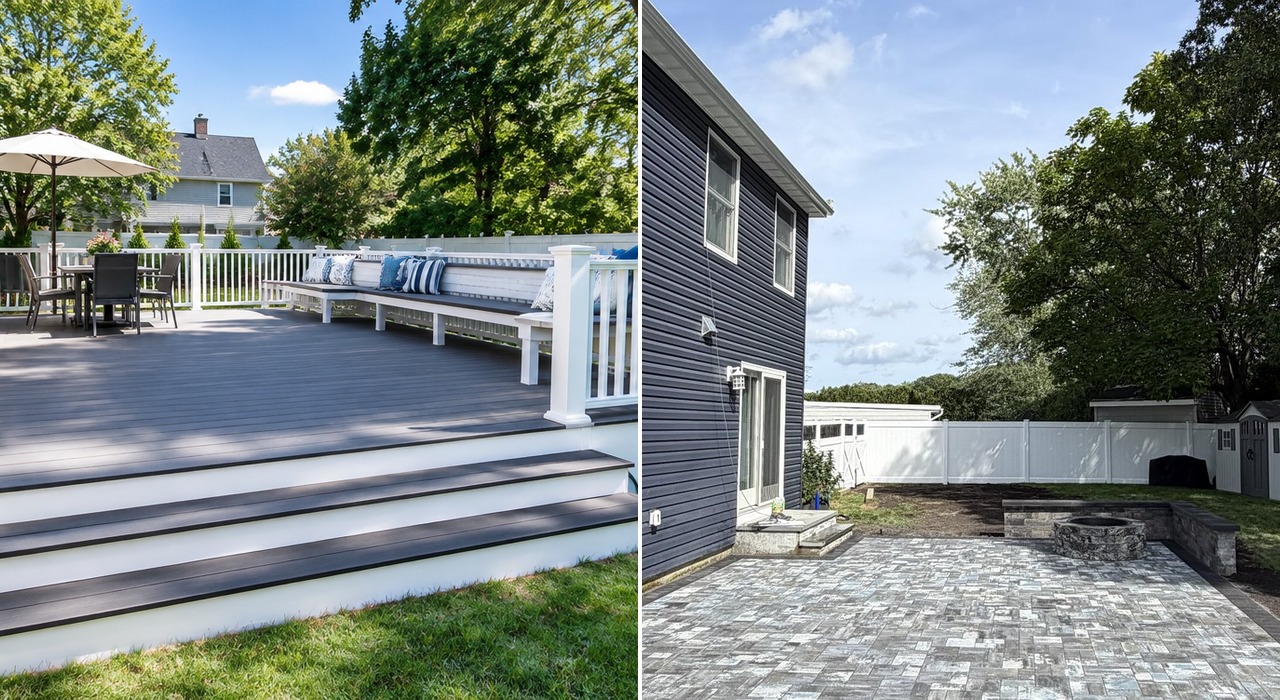
A paver patio and deck can also work together. Some of the most striking Long Island backyards combine a small elevated deck off the back door with a larger paver patio at ground level, connected by stone steps. This approach uses each material where it performs best and creates visual interest through the level change.
Resale Value and Return on Investment
Both outdoor living spaces add value to a Long Island home, but the return differs. A paver patio typically returns 80 to 100 percent of the installation cost at resale, according to industry data. The high return comes from low perceived maintenance and long expected lifespan. Buyers see a paver patio as a finished feature that will not need attention or replacement for decades.
A wood deck returns 60 to 75 percent of its cost, and that percentage drops as the deck ages and shows wear. Buyers looking at a 10-year-old wood deck see a maintenance obligation and a future replacement cost, which reduces the perceived value. The deck vs patio cost advantage at resale clearly favors hardscaping.
A composite deck returns 65 to 80 percent of its cost at resale. The perception of composite as low-maintenance helps, but the higher installation cost means the dollar amount recovered is not always better than a paver patio despite the similar percentage.
Real estate agents on Long Island consistently report that outdoor living spaces are among the most requested features for home buyers. A well-designed paver patio and deck combination or a standalone paver patio with a fire pit and seating wall creates the kind of backyard that sells homes faster.
Which Is Right for Your Backyard
Choosing between a paver patio and deck depends on your specific situation. Here are the scenarios where each option makes the most sense.
Choose a paver patio if your back door is at or near ground level, you want the lowest possible maintenance, you plan to add features like a fire pit or outdoor kitchen, you want the longest lifespan for your investment, or you prefer not to deal with annual staining and sealing. The deck vs patio cost advantage, combined with superior durability and minimal maintenance, makes a paver patio the better value for most Long Island homeowners.
Choose a deck if your home has a high foundation that requires an elevated outdoor surface, you specifically want an elevated platform with railings, or your yard has conditions that make ground-level construction difficult such as steep slopes or high water tables.
Choose both if your budget allows and your yard has the space. A small deck for the transition from the house plus a larger paver patio for the main outdoor living area gives you the best of both options.
Affordable Patio provides free consultations and estimates for paver patio projects across Long Island. We assess your yard conditions, door height, drainage, and design goals to recommend the best approach for your home. Call (631) 275-3142 or visit our contact page to schedule your consultation.
Frequently Asked Questions
Is a paver patio cheaper than a deck on Long Island?
Yes. The deck vs patio cost comparison favors a paver patio both upfront and over time. A paver patio costs $10 to $25 per square foot installed, while a wood deck costs $15 to $35 and a composite deck costs $25 to $60. When you add 20 years of deck maintenance vs paver maintenance costs, the total savings from choosing a paver patio can reach $10,000 to $15,000 on a 300-square-foot project.
How long does a paver patio last compared to a deck?
A paver patio lasts 30 to 50 years with minimal maintenance. A wood deck lasts 15 to 25 years with regular staining and sealing, and a composite deck lasts 25 to 30 years. The paver patio and deck lifespan difference means you may need to replace a wood deck twice in the same period that a single paver patio remains in service.
Do I need a permit for a patio or a deck on Long Island?
Most ground-level paver patios on Long Island do not require a building permit. Decks attached to the house typically do require a permit in Suffolk County and Nassau County, which costs $200 to $500 and adds two to six weeks to the project timeline. This permit requirement is another factor in the deck vs patio cost comparison.
Can I put a fire pit on a deck?
Fire pits on wood or composite decks are generally not recommended and may violate local fire codes on Long Island. The heat can damage deck boards, and the fire risk to a combustible surface is significant. A paver patio is the safer and more practical surface for a fire pit, which is one reason the paver patio and deck comparison favors hardscaping for homeowners who want a fire feature.
Which is better for resale value on Long Island?
A paver patio typically returns 80 to 100 percent of the installation cost at resale, while a wood deck returns 60 to 75 percent. The raised deck vs ground level patio resale comparison favors the patio because buyers perceive it as a long-lasting, low-maintenance feature. Real estate agents on Long Island consistently list outdoor living spaces as top buyer priorities.
How much maintenance does a composite deck need?
Composite decks need cleaning two to three times per year to prevent mold and mildew, plus periodic inspection and maintenance of the wood structural framing underneath. The deck maintenance vs paver maintenance comparison shows that even composite decks require more attention than a paver patio. The structural framing under a composite deck is still pressure-treated wood, which is vulnerable to the same moisture and insect issues as a fully wood deck.
Conclusion
For most Long Island homeowners, a paver patio delivers better value than a deck across every major category. The deck vs patio cost advantage is clear both at installation and over 20 years of ownership. The deck maintenance vs paver maintenance comparison shows dramatically less time and money spent on upkeep. And when it comes to durability in Long Island’s demanding climate, a paver patio and deck comparison consistently favors hardscaping.
Affordable Patio has helped more than 2,000 Long Island homeowners create outdoor living spaces that last. Every installation uses Cambridge Pavingstones with ArmorTec and includes a 3-year workmanship warranty. Whether you need a simple patio, a raised deck vs ground level patio assessment, or a complete backyard design, we provide free estimates within 12 to 24 hours. Call (631) 275-3142 or visit our Build and Price page to get started today.