
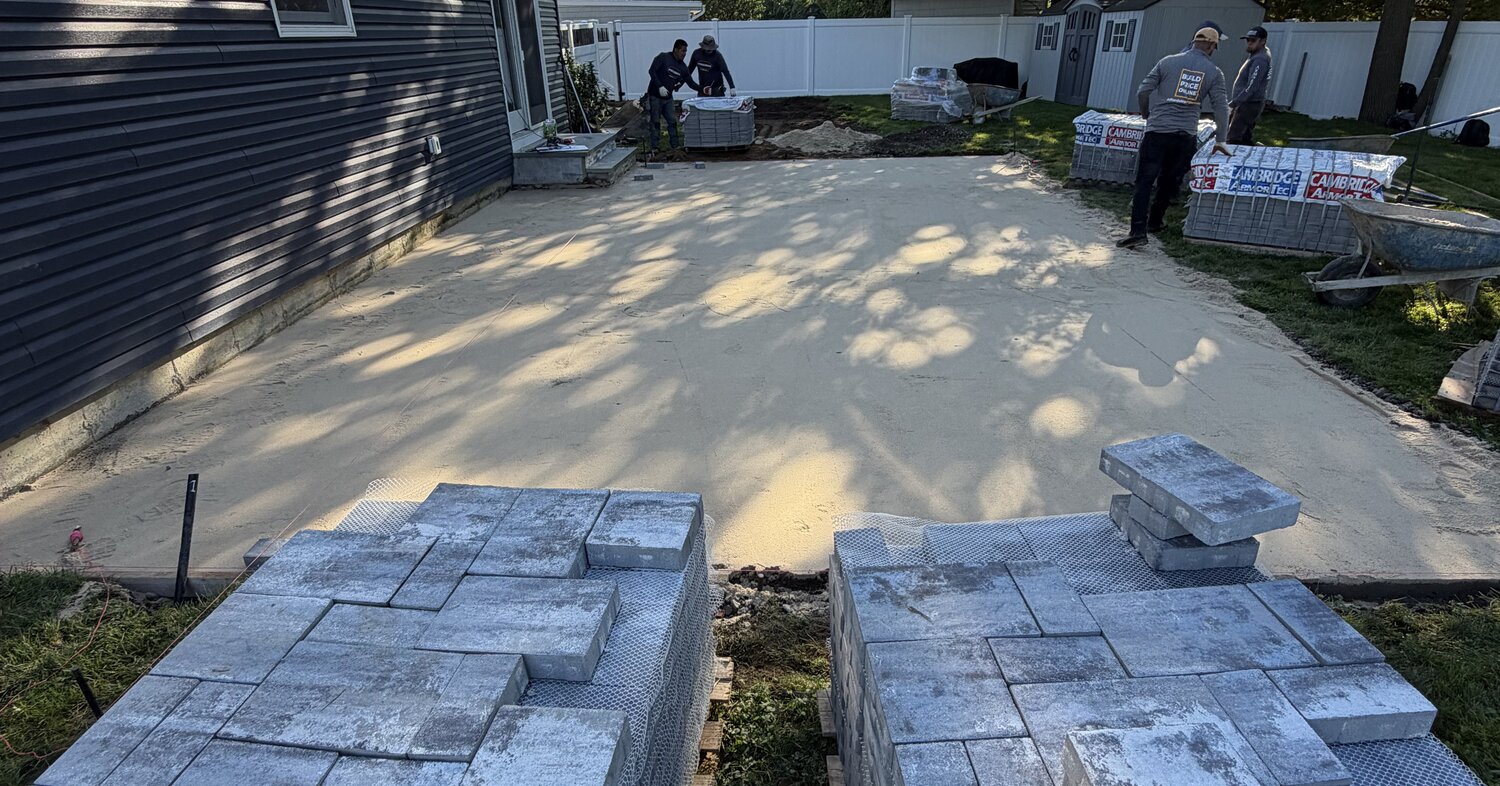
Getting the paver base depth on Long Island right is the difference between a patio or driveway that lasts twenty years and one that settles, shifts, and cracks within the first few seasons. Long Island soil conditions, especially the clay-heavy areas found across much of Suffolk County and Nassau County, demand deeper and more carefully compacted bases than what generic installation guides recommend. This guide covers the exact paver base depth on Long Island specifications for both patios and driveways so you can hold your contractor accountable and protect your investment.
Affordable Patio has installed more than 2,000 paver projects across Long Island over the past 15 years. Every project starts with proper base preparation because we know that the base is the foundation of everything above it. The gravel base depth pavers need varies by application, and we break down the numbers below.
Quick answer: On Long Island, a paver patio needs 4 to 6 inches of compacted gravel base in sandy soil and 6 to 8 inches in clay soil. A paver driveway needs 8 to 12 inches of compacted gravel base depending on soil conditions. Both applications require 1 inch of bedding sand on top of the gravel. Proper paver base compaction in lifts of no more than 4 inches is critical for long-term stability. Call Affordable Patio at (631) 275-3142 for a free estimate that includes full base preparation.
Table of Contents
- Why Paver Base Depth Matters on Long Island
- Patio Base Depth Standards for Long Island
- Driveway Base Depth Requirements
- Driveway Base vs Patio Base Comparison
- How Long Island Soil Affects Your Base
- Paver Base Compaction Best Practices
- Choosing the Right Gravel for Your Paver Base
- Common Base Depth Mistakes to Avoid
- Frequently Asked Questions
Why Paver Base Depth Matters on Long Island
The base layer under your pavers serves three functions. It distributes the weight of foot traffic or vehicle loads across a wider area so the soil underneath does not compress unevenly. It provides drainage so water moves away from the surface instead of pooling under the pavers. And it creates a stable, level platform that prevents the pavers from shifting or settling over time.
On Long Island, the paver base depth on Long Island requirements are more demanding than in many other parts of the country. The reason is our soil. Large portions of Suffolk County and Nassau County sit on glacial deposits that include layers of clay, silt, and sand in unpredictable combinations. Clay soil holds water, expands when wet, and contracts when dry. This seasonal movement can lift, tilt, and crack pavers that sit on an insufficient base.
The freeze-thaw cycle makes everything worse. Long Island typically experiences 40 to 60 freeze-thaw cycles per winter. Each cycle pushes moisture in the soil to expand as it freezes and contract as it thaws. A shallow base allows this movement to reach the pavers directly. A properly deep base with the right gravel base depth pavers need acts as a buffer zone that absorbs this movement before it reaches the surface.
Getting the paver base depth on Long Island right from the start is always cheaper than fixing a failed installation later. Pulling up settled pavers, re-excavating, installing a proper base, and re-laying the pavers costs two to three times more than doing it right the first time.
Patio Base Depth Standards for Long Island
A residential paver patio on Long Island needs a minimum of 4 inches of compacted gravel base in areas with well-draining sandy soil. In areas with clay soil or mixed soil conditions, the gravel base depth pavers require increases to 6 to 8 inches. The ICPI technical standards recommend 4 to 6 inches for pedestrian applications in established areas, and 6 to 8 inches in newer developments where the soil has not fully consolidated.
On top of the gravel base, every patio needs 1 inch of bedding sand. This sand layer provides the final leveling surface that the pavers sit on. The bedding sand is screeded to a precise, even thickness using pipe rails or screed bars. Too much bedding sand causes settling. Too little makes it impossible to level the pavers properly.
The total excavation depth for a typical Long Island patio is 7 to 10 inches. This accounts for the gravel base, the bedding sand, and the thickness of the pavers themselves. Cambridge Pavingstones, which Affordable Patio uses exclusively, are typically 2 3/8 inches thick for patio applications. So for a patio with 6 inches of base, 1 inch of sand, and 2 3/8 inches of paver, the total excavation depth is approximately 9 1/2 inches.
The gravel base depth pavers need for a patio also depends on the patio’s intended use. A simple walkway or garden path can get away with 4 inches of compacted base. A dining patio that will hold furniture, a grill, and regular foot traffic needs at least 6 inches. A patio that will support a hot tub, outdoor kitchen, or fire pit needs 8 inches or more because of the concentrated weight of these features. Proper paver base compaction is essential at every depth level to achieve the load-bearing capacity the project requires.
Driveway Base Depth Requirements
Driveways require significantly more base depth than patios because they must support vehicle loads. A passenger car weighs 3,000 to 5,000 pounds, and that weight is concentrated on four small tire contact patches. The base must distribute these loads without allowing the pavers to flex, rock, or settle under repeated traffic.
The standard gravel base depth pavers need for a residential driveway on Long Island is 8 to 12 inches of compacted crusher run or dense-graded aggregate. In areas with poor soil conditions, particularly the clay-heavy zones found in parts of Smithtown, Huntington, and along the North Shore, the base depth should increase to 10 to 14 inches. This is a major difference when comparing driveway base vs patio base requirements. A driveway base vs patio base comparison shows that driveways need roughly double the gravel thickness.
Driveway pavers themselves are also thicker than patio pavers. The ICPI recommends a minimum paver thickness of 3 1/8 inches (80 mm) for vehicular applications. Cambridge Pavingstones offers several driveway-rated paver options at this thickness. Combined with the deeper base, the total excavation depth for a Long Island paver driveway is typically 12 to 17 inches.
The bedding sand layer for driveways remains at 1 inch, the same as for patios. However, the bedding material for driveways should be a coarse concrete sand rather than a fine mason sand. The coarser particles interlock better under vehicle loads and resist displacement from tire friction. Some contractors use a manufactured stone dust for driveway bedding, which provides even better interlock and load distribution.
Paver base compaction for driveways is even more critical than for patios. Each lift of gravel must be compacted to at least 95 percent of maximum dry density, which is the industry standard for vehicular applications. Affordable Patio uses plate compactors rated for the job and verifies compaction at multiple points across the base before proceeding to the bedding layer.
Driveway Base vs Patio Base Comparison
Understanding the driveway base vs patio base differences helps you evaluate contractor proposals and catch potential shortcuts. Here is a side-by-side comparison of the key specifications for each application on Long Island.
| Specification | Patio Base | Driveway Base |
|---|---|---|
| Compacted gravel depth (sandy soil) | 4 to 6 inches | 8 to 10 inches |
| Compacted gravel depth (clay soil) | 6 to 8 inches | 10 to 14 inches |
| Bedding sand | 1 inch | 1 inch |
| Paver thickness | 2 3/8 inches (60 mm) | 3 1/8 inches (80 mm) |
| Total excavation depth | 7 to 11 inches | 12 to 17 inches |
| Compaction standard | 95% minimum | 95% minimum |
| Geotextile fabric | Recommended | Required |
The driveway base vs patio base cost difference is also significant. A deeper base means more excavation, more gravel material, more trucking, and more compaction time. For a typical 600-square-foot project, the base preparation alone costs $2,400 to $3,600 for a patio and $4,800 to $7,200 for a driveway. The driveway base vs patio base price gap grows wider on properties with clay soil because the additional excavation depth adds more material and labor.
One specification that stays the same across both applications is the edge restraint. Both patios and driveways need a rigid edge restraint, either a concrete border, a paver-specific plastic edge restraint spiked into the base, or an existing concrete curb. Without edge restraint, the pavers at the perimeter will creep outward over time and open up the joint pattern.
How Long Island Soil Affects Your Base
Long Island’s geology is a direct result of the last ice age. The island is essentially a pile of glacial debris left behind when the Wisconsin glacier retreated roughly 20,000 years ago. The North Shore sits on the Harbor Hill moraine, which consists of a chaotic mix of clay, silt, boulders, and sand. The South Shore and central parts of the island tend toward sandier, better-draining soils deposited by the glacier’s outwash plain.
This geological diversity means that the paver base depth on Long Island cannot be a one-size-fits-all number. Two properties a mile apart can have completely different soil conditions. A home in Babylon with sandy soil might need only 4 inches of base for a patio, while a property in Smithtown sitting on dense clay might need 8 inches for the same patio application.
Clay soil is the biggest challenge for paver installations on Long Island. Clay has a California Bearing Ratio (CBR) of only 3 to 5, meaning it provides very little structural support. Sandy soil has a CBR of 10 to 30, making it three to ten times more supportive. The lower the CBR value, the deeper the gravel base depth pavers require to compensate for the weak subgrade.
Affordable Patio evaluates soil conditions on every project before finalizing the base design. We dig test holes at multiple points across the project area to identify the soil type and check for water table issues. On properties where clay is present, we install geotextile fabric between the subgrade and the gravel base. This fabric prevents the clay from migrating up into the gravel and compromising the base over time, which is a common failure mode on Long Island projects where this step is skipped.
The water table is another Long Island-specific concern. Parts of the South Shore have water tables as shallow as 3 to 5 feet below grade. A high water table means the soil stays saturated for extended periods, which reduces its load-bearing capacity and increases the risk of frost heave. In these areas, the paver base depth on Long Island must account for poor drainage by using open-graded aggregate that allows water to pass through freely rather than pooling at the base level.
Paver Base Compaction Best Practices
Even the deepest, highest-quality gravel base will fail if it is not properly compacted. Paver base compaction is the single most important step in the entire installation process. A base that is spread but not compacted will settle unevenly under load, creating dips, humps, and loose pavers within the first year.
The key to proper paver base compaction is working in lifts. A lift is a single layer of gravel that gets spread and compacted before the next layer goes on top. The maximum lift thickness is 4 inches of loose material, which compacts down to approximately 3 inches. Trying to compact more than 4 inches at a time leaves the bottom portion loose because the compaction energy from the plate compactor does not penetrate deep enough.
For a 6-inch patio base, this means two lifts. Spread 4 inches of gravel, compact it, then spread another 3 to 4 inches and compact again. For a 12-inch driveway base, you need three to four lifts. Each lift must be compacted to 95 percent of maximum dry density, which is verified using a hand-operated density gauge or a nuclear density meter on larger projects.
Moisture content matters during paver base compaction. The gravel should be damp but not saturated. Dry gravel does not compact well because there is no moisture to help the particles settle against each other. Saturated gravel pumps water during compaction and never reaches the target density. The ideal moisture content is 6 to 8 percent for most crusher run aggregates. On hot days, your contractor should mist the gravel lightly with a hose before each compaction pass.
The type of compactor also matters. A walk-behind plate compactor weighing 200 to 300 pounds is sufficient for most patio bases. Driveway bases need a heavier plate compactor in the 400 to 500 pound range, or a vibratory roller for large projects. Affordable Patio uses commercial-grade Cambridge Pavingstones equipment and follows ICPI compaction standards on every project to ensure paver base compaction meets the required specifications.
Choosing the Right Gravel for Your Paver Base
Not all gravel is suitable for a paver base. The right material is a dense-graded aggregate, commonly called crusher run, quarry process, or QP. This is a blend of crushed stone from 3/4 inch down to fine dust particles. The mix of sizes is what makes it work. The larger stones provide structural strength while the finer particles fill the gaps and create a tight, interlocking matrix when compacted.
The most common base material for the gravel base depth pavers need on Long Island is 3/4-inch crusher run. This product is widely available from local quarries and aggregate suppliers across Suffolk County and Nassau County. It compacts well, drains adequately, and provides excellent load distribution. The gravel base depth pavers require should always be filled with this type of angular, crushed stone rather than rounded river gravel.
Rounded gravel, sometimes called pea gravel or river rock, should never be used as a structural base layer. Round stones roll against each other under load instead of locking together. A base made of rounded gravel will shift and settle no matter how deep it is or how well it is compacted. This is one of the most common mistakes made by inexperienced contractors, and it leads to premature failure of the paver surface.
For driveways and heavy-use areas, some contractors specify a two-layer base system. The bottom layer uses a larger aggregate, such as 1 1/2-inch crusher run or recycled concrete, to provide the primary structural support. The top layer uses standard 3/4-inch crusher run to create a smoother surface for screeding the bedding sand. This two-layer approach increases the overall load capacity and is recommended when the driveway base vs patio base load requirements exceed standard residential specifications.
Geotextile fabric is installed between the subgrade and the first layer of gravel on every Long Island project where clay or silt is present in the soil. This non-woven polypropylene fabric allows water to pass through while preventing fine soil particles from migrating into the gravel base. Without geotextile, clay particles gradually fill the voids in the gravel, reducing its drainage capacity and structural integrity over time.
Common Base Depth Mistakes to Avoid
After 15 years and thousands of paver projects on Long Island, Affordable Patio has seen every base preparation mistake in the book. Here are the most common ones and how they lead to premature failure.
The first and most costly mistake is an insufficient base depth. Some contractors cut corners by installing only 2 to 3 inches of base for a patio or 4 to 6 inches for a driveway. This might look fine for the first season, but the paver base depth on Long Island needs to account for our freeze-thaw cycles and variable soil conditions. A shallow base is the number one cause of paver settling and shifting on Long Island.
The second mistake is skipping compaction or compacting the entire base as a single lift. Spreading 8 inches of gravel and running a compactor over the top only compacts the top 3 to 4 inches. The bottom half stays loose and will settle under load. Every base must be compacted in lifts of no more than 4 inches. Proper paver base compaction in lifts is non-negotiable for a long-lasting installation.
The third mistake is using the wrong material. Rounded gravel, topsoil mixed with gravel, or recycled asphalt millings are not suitable base materials for a paver project. The base must be angular, crushed stone that locks together when compacted. The gravel base depth pavers need should always consist of clean, angular crusher run from a reputable aggregate supplier.
The fourth mistake is ignoring drainage. A base without proper drainage is a base that will fail. Water that cannot escape through the base becomes trapped, saturates the soil beneath, and creates the conditions for frost heave. Every paver base needs adequate slope, typically 1 to 2 percent away from structures, and the gravel itself must be free-draining.
The fifth mistake is not accounting for the soil type. A contractor who uses the same base depth on every project regardless of soil conditions is taking a shortcut. The paver base depth on Long Island must be adjusted based on actual soil conditions found on your specific property. A proper contractor digs test holes, evaluates the soil, and adjusts the base design accordingly.
Frequently Asked Questions
How deep should a paver base be for a patio on Long Island?
A paver patio on Long Island needs 4 to 6 inches of compacted gravel base in sandy, well-draining soil. In clay soil, which is common across many parts of Suffolk County and Nassau County, the base depth should increase to 6 to 8 inches. On top of the gravel, add 1 inch of bedding sand. The paver base depth on Long Island is deeper than national averages because of our freeze-thaw cycles and variable soil conditions.
What is the recommended driveway base depth for pavers on Long Island?
A paver driveway on Long Island needs 8 to 12 inches of compacted gravel base for standard residential use. Properties with clay soil or poor drainage may need 10 to 14 inches. The driveway base vs patio base depth difference exists because driveways must support vehicle loads of 3,000 to 5,000 pounds concentrated on four tire contact patches, while patios only carry foot traffic.
What type of gravel is best for a paver base on Long Island?
The best base material is 3/4-inch crusher run, also called quarry process or QP. This dense-graded aggregate has a mix of stone sizes from 3/4 inch down to fine particles that lock together when compacted. Never use rounded gravel like pea gravel or river rock for a structural base. The gravel base depth pavers need must always be filled with angular, crushed stone that interlocks under compaction.
How important is compaction for a paver base?
Paver base compaction is the single most critical step in any paver installation. Without proper compaction, even a deep base will settle and shift. The gravel must be compacted in lifts of no more than 4 inches. Each lift should reach 95 percent of maximum dry density. A poorly compacted base is the leading cause of paver failure on Long Island, regardless of the gravel depth.
Does a paver base need geotextile fabric on Long Island?
Yes, geotextile fabric is strongly recommended for every paver project on Long Island and is essential on properties with clay or silt soil. The fabric is installed between the subgrade and the first layer of gravel. It prevents fine soil particles from migrating into the gravel base and reducing its drainage and structural capacity. On driveway projects, geotextile fabric is considered a requirement rather than an option.
Why is the paver base depth different on Long Island compared to other regions?
The paver base depth on Long Island is generally deeper than in warmer climates because of two factors. First, Long Island experiences 40 to 60 freeze-thaw cycles per winter, and each cycle pushes moisture in the ground to expand and contract. A deeper base absorbs this movement before it reaches the pavers. Second, large portions of Long Island have clay soil from glacial deposits. Clay provides poor structural support and holds water, so the driveway base vs patio base specifications both need to be increased to compensate for this weak subgrade material.
Conclusion
The paver base depth on Long Island depends on your application, your soil type, and your specific property conditions. For patios, plan on 4 to 8 inches of compacted gravel base. For driveways, plan on 8 to 14 inches. Always use angular crusher run, always compact in lifts, and always install geotextile fabric on clay soil. The driveway base vs patio base specifications are different for good reason, and cutting corners on either one leads to costly repairs down the road.
Affordable Patio builds every project on a properly engineered base using Cambridge Pavingstones with ArmorTec. We evaluate your soil, design the right base depth for your property, and compact every lift to ICPI standards. With over 15 years of experience and more than 2,000 completed projects across Suffolk County and Nassau County, we know exactly what Long Island soil demands. Paver base compaction and proper gravel base depth pavers need are not things we take shortcuts on.
Call Affordable Patio today at (631) 275-3142 for a free estimate on your paver patio or driveway project. We respond within 12 to 24 hours, and financing is available for qualified homeowners. Visit our Build and Price page to start planning your project today.