
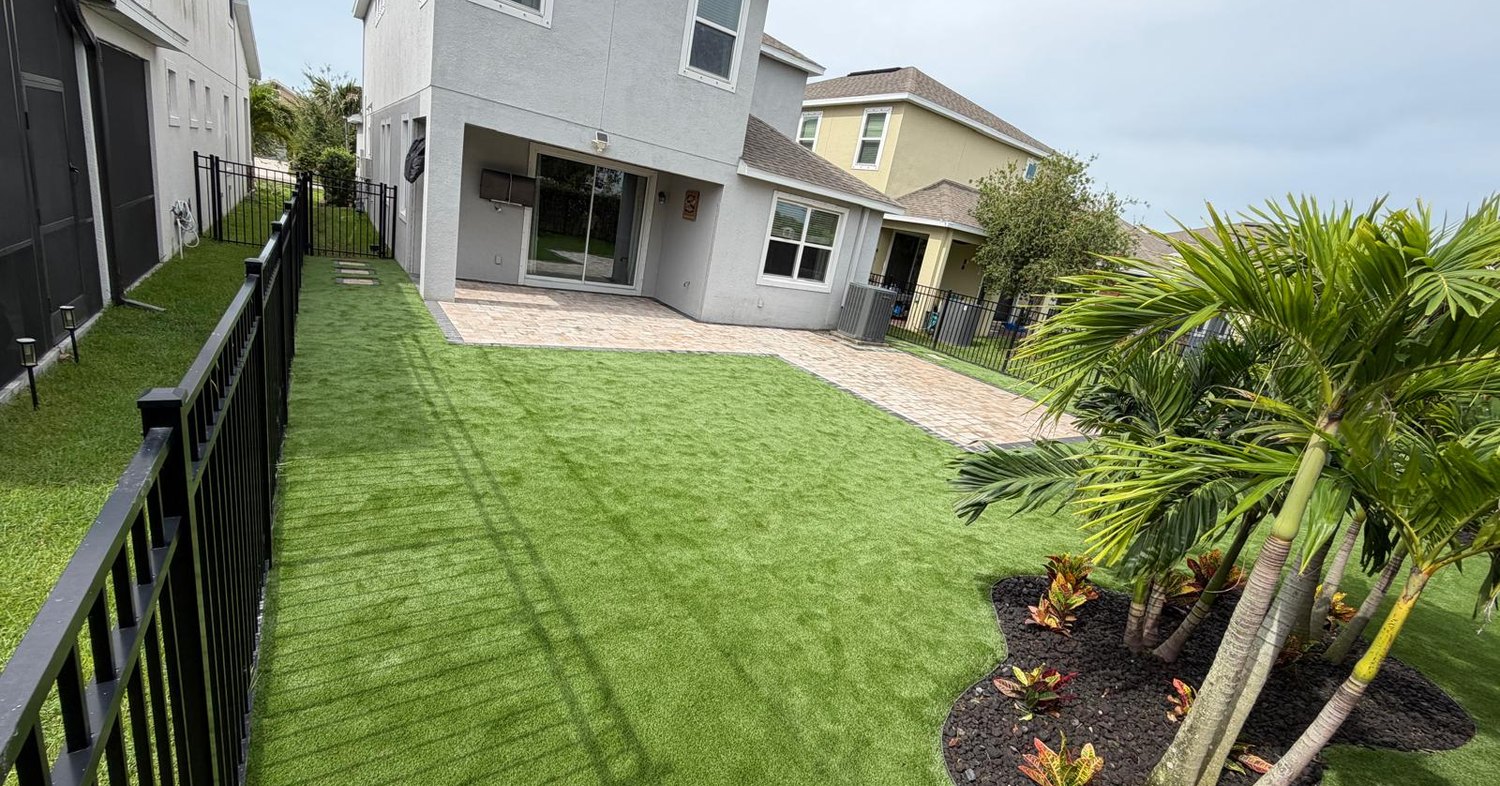
A patio base for sandy soil in Hillsborough County has to be built around water, not around the sand. We have installed more than 2,000 patios across Florida in over 15 years, and the failures we get called out to repair are rarely a sand problem. They are drainage, compaction, or both.
This guide covers what the published specifications say and where two of them disagree. Some figures come from CMHA tech notes, some from the Florida Department of Transportation, and one is ours. We keep them separate, because a patio base for sandy soil sold on blended numbers is how arguments start.
Quick answer: A patio base for sandy soil needs a compacted subgrade, a compacted aggregate base, and about 1 inch of screeded bedding sand. CMHA tech note PAV-TEC-010 publishes 4 to 6 inches for walks and 6 to 8 inches for driveways. We spec 2 to 4 inches of crushed concrete on many Florida patios.
Table of Contents
Why a Patio Base for Sandy Soil Fails in Hillsborough County
Sandy Spodosols are the most extensive soils in Florida, roughly 8.4 million acres, and UF/IFAS reports that most of them are poorly or very poorly drained and widespread on flatwoods landscapes. The USDA NRCS describes Myakka fine sand, the state soil, as sandy, siliceous and hyperthermic, very poorly or poorly drained, with a water table shallower than 18 inches for 1 to 4 months in most years over about 1,400,072 acres.
CMHA’s subgrade table makes the point in a single row. A clean, poorly graded sand with good drainage rates CBR 9, while a plastic clay with good drainage rates only CBR 2. The same sand with poor drainage falls to CBR 3. Sand is a strong subgrade until it stays wet, which is why a patio base for sandy soil anywhere in Hillsborough County is a drainage decision first.
Florida Paver Base Depth: What CMHA Publishes and What We Spec
CMHA tech note PAV-TEC-010 publishes minimum aggregate base thickness of 4 to 6 inches for walks, 6 to 8 inches for driveways and 8 to 12 inches for streets, and states that thicknesses may be greater depending on site conditions, traffic and review by a qualified design professional. PAV-TEC-004-23 adds a constructability floor of 4 inches below 500,000 equivalent single axle loads and 6 inches above that.
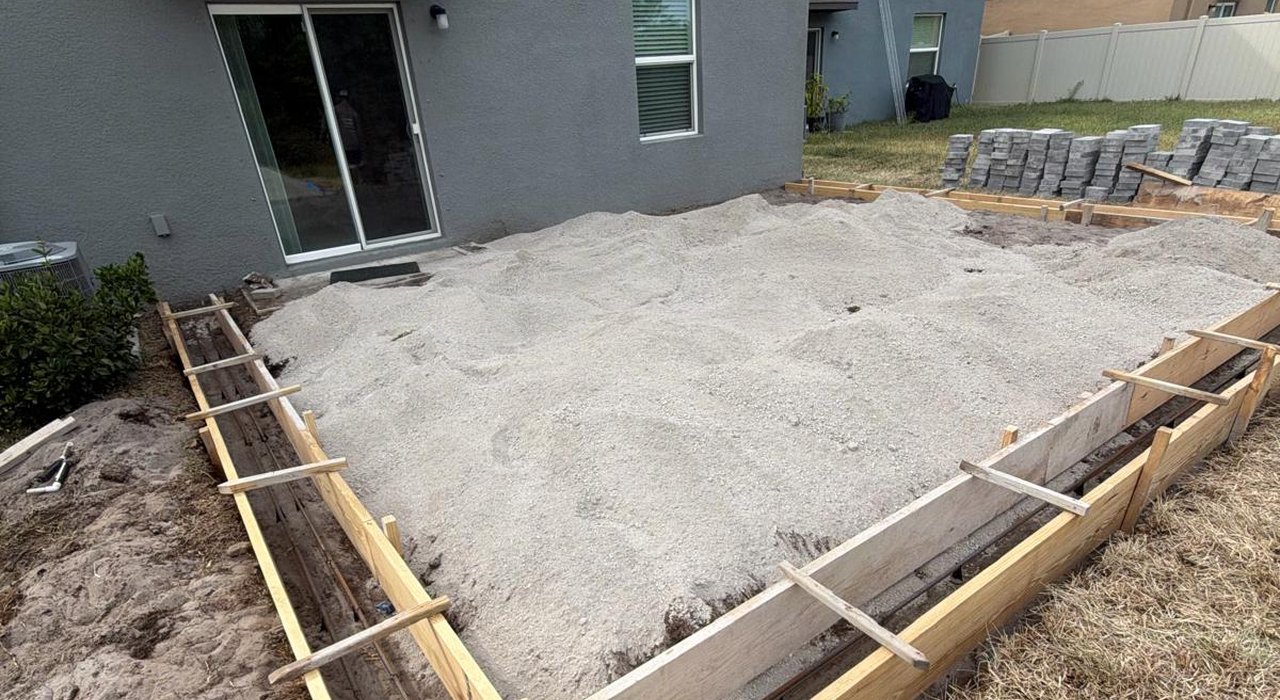
Our Florida pages publish 2 to 4 inches of crushed concrete for our local soil conditions. That is our figure for a light duty patio on a known site, not the CMHA specification. Both hold, because CMHA itself ties Florida paver base depth to soil, drainage and use. On a paver patio that carries foot traffic and drains freely, a patio base for sandy soil is shallower than the one we build under a driveway.
Soil Compaction Florida Crews Skip, and Two Figures That Conflict
CMHA PAV-TEC-004-23, the structural design note, calls for subgrade compaction of at least 95 percent standard Proctor density by AASHTO T-99 or ASTM D698 in cohesive clay soils, and at least 95 percent modified Proctor density by AASHTO T-180 or ASTM D1557 in cohesionless sandy soils. The effective depth of compaction should reach at least the top 12 inches.
CMHA PAV-TEC-010, the application guide, publishes a different figure: at least 98 percent Proctor density per ASTM D698 for pedestrian areas and residential driveways. The two notes have different scopes, so we never average them, and we quote a patio base for sandy soil from the note the number came out of. FDOT asks for 98 percent of modified Proctor by FM 1-T180 Method D, in lifts of no less than 3 inches once thickness passes 6 inches, and that is a highway specification.
Crushed Concrete Base, LBR 150, and the 3 Foot Water Rule
FDOT Section 285 lists Recycled Concrete Aggregate as a permitted optional base course at LBR 150, against LBR 100 for limerock and shell base. The Flexible Pavement Design Manual gives it a 0.18 structural coefficient, equal to limerock and above graded aggregate at 0.15. Section 911 caps deleterious material at 1 percent by weight for bituminous concrete, 1 percent for bricks and 0.1 percent for reinforcing steel, and the material is barred from interstate roadways.
The same manual requires 3 feet of base clearance above high water and penalizes less, with a 25 percent design modulus reduction at 2 feet and 50 percent at 1 foot. Those are highway specifications, not residential patio requirements. We borrow the principle instead of the number, because a patio base for sandy soil should sit as far above seasonal saturation as the yard allows.
Bedding Sand and Edges in a Patio Base for Sandy Soil
Bedding sand is screeded to a nominal 1 inch uncompacted in PAV-TEC-002-22, or 1 to 1 1/2 inches uncompacted at consistent thickness in PAV-TEC-010. It should meet ASTM C33 grading with an added limit of 1 percent passing the No. 200 sieve. Limestone screenings, stone dust and mason sand are not recommended, because they are unevenly graded, carry excess fines and break down from wetting and abrasion.
- An uneven base is never corrected with extra bedding sand, because CMHA warns that the unevenness reflects through to the surface over time.
- CMHA recommends geotextile over silt and clay subgrades, and it does not name sand as the trigger.
- The valid Florida clause is the other one: areas where soil remains saturated part of the year.
- On residential work, compacted base should extend no more than 10 inches past the edge restraint stakes.
| Decision | CMHA | FDOT | Florida twist |
|---|---|---|---|
| Subgrade rating | PAV-TEC-004-23: sand CBR 9 drained, CBR 3 wet | Not a patio spec | Flatwoods lots stay wet |
| Subgrade density | PAV-TEC-004-23: 95 percent modified. PAV-TEC-010: 98 percent | 98 percent modified, FM 1-T180 | Wet sand resists density |
| Base thickness | PAV-TEC-010: 4 to 6 inches walks, 6 to 8 driveways | 3 inch lifts minimum | We publish 2 to 4 inches |
| Base material | Unbound base at CBR 80 percent | Recycled concrete LBR 150, limerock 100 | Easy to source locally |
| Water clearance | Remove standing water | 3 feet above high water | Saturation peaks in summer |
| Bedding and edges | 1 inch sand, ASTM C33 | Not a patio spec | Rain finds weak edges |
Want your patio base for sandy soil in writing before you sign? We put excavation depth, base material and compaction target in the estimate, so you can compare bids fairly. Call (813) 777-5665 for a free estimate within 24 hours in Hillsborough County.
Patio Settling Sand Loss and Sinkholes in Hillsborough County
CMHA PAV-TEC-006-22 documents the chain, and no part of it involves frost. A saturated base lets bedding sand pump under load, joint sand washes out, lateral restraint is lost, joints widen at the outer edge, and pavers begin to rotate. Depressions trace back to settlement of the subgrade or granular base, often from inadequate compaction. Joint sand also leaves through pressure washing, driving winds, concentrated runoff and excessive cleaning.
Ground movement is the other factor. Florida DEP explains that sinkholes form in karst terrain when surface sediments collapse into voids in the limestone, with drought, earth moving, heavy rain and intense groundwater pumping as likely triggers. USGS Circular 1182 records 64 new sinkholes within a 1 mile radius of a Tampa Bay well field within 1 month of a pumping increase, and 22 at Dover, Hillsborough County, Florida in January 1977.
Planning a patio in Manatee County or Hillsborough County? We have worked these soils for over 15 years, we back the job with a 3 year warranty, and estimates come back within 24 hours. Call (813) 777-5665 or use our Florida contact page.
Frequently Asked Questions
How deep does a paver patio base need to be here?
CMHA PAV-TEC-010 publishes 4 to 6 inches for walks and 6 to 8 inches for driveways. We publish 2 to 4 inches of crushed concrete on light duty patios. Florida paver base depth moves with soil, drainage and use.
Does sandy soil always need geotextile underneath?
No. CMHA recommends geotextile over silt and clay subgrades, not over sand. The published clause that fits our region is different: areas where soil remains saturated part of the year. On a flatwoods lot, that is the honest reason.
What compaction percentage should a contractor hit?
It depends on the document. PAV-TEC-004-23 asks for 95 percent modified Proctor in sandy soils, while PAV-TEC-010 asks for 98 percent. Soil compaction Florida work should never blend the two, so ask which tech note the number came from.
Is a crushed concrete base a good choice in Florida?
FDOT rates Recycled Concrete Aggregate at LBR 150 against limerock at LBR 100, with the same 0.18 structural coefficient. It is barred from interstate roadways. Those are highway specifications, so treat them as evidence, not a patio rule.
Why did my patio sink after two rainy seasons?
Usually a patio base for sandy soil was saturated or under compacted. Patio settling sand pumping follows, joint sand washes out, and restraint is lost. Once joints widen within a foot or two of the edge, pavers rotate quickly.
Getting a Patio Base for Sandy Soil Right in Manatee County
Ask three questions before you sign. What is the excavation depth, what is the base material, and what compaction standard will the crew hit, quoted by tech note number. A bidder who answers all three has read them. Read the CMHA structural design note yourself at PAV-TEC-004.
Soil changes from Ruskin to Parrish, so we grade for the seasonal water table, compact in lifts, and hold the crushed concrete base to the edge restraint spec across Manatee County and our wider Florida service area.
Let us spec your patio base for sandy soil before anyone breaks ground. Call (813) 777-5665, tell us the town and what the yard does after a hard rain, and we will send a free written estimate within 24 hours.