
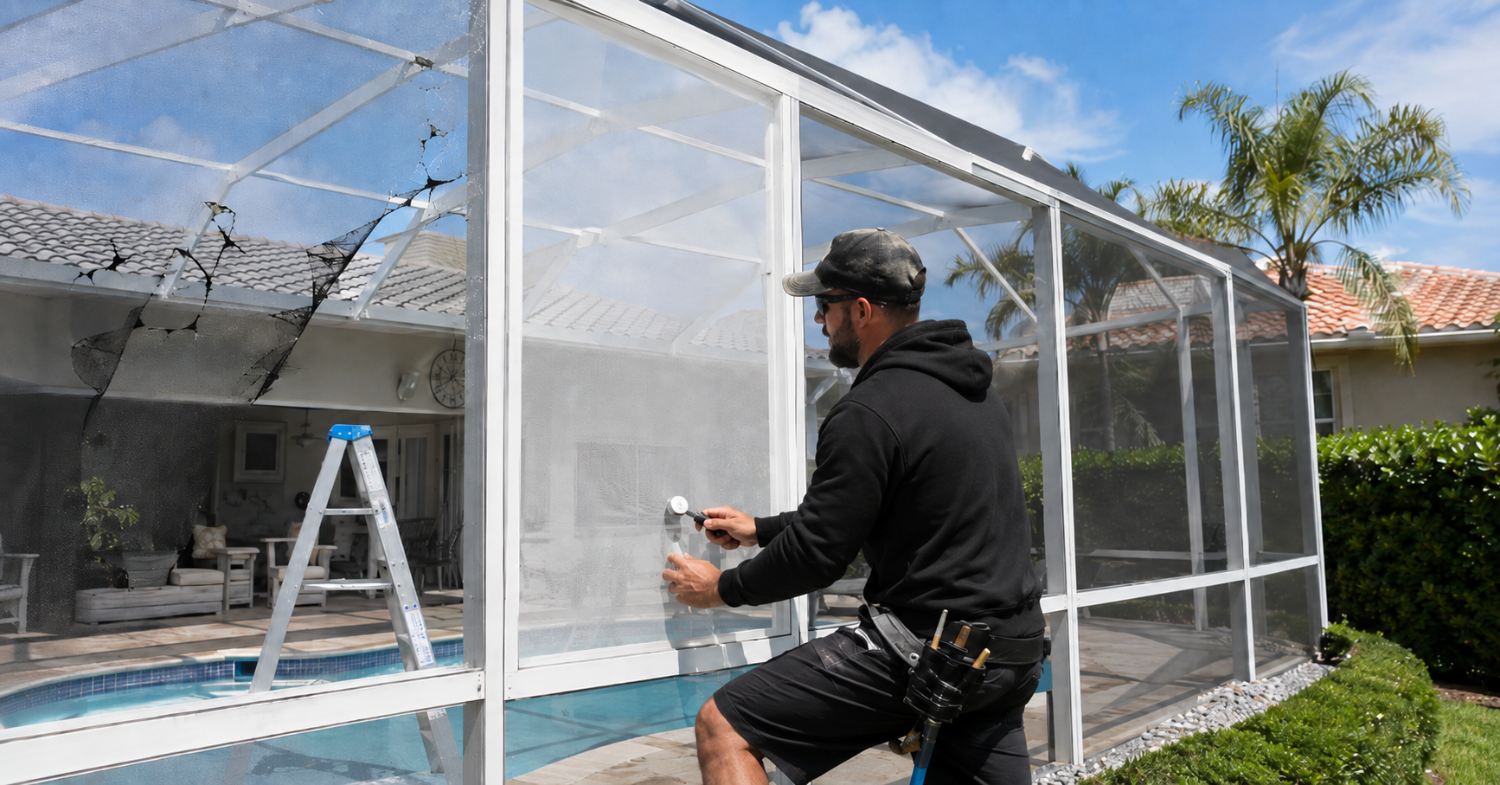
Lanai rescreening is one of the most predictable maintenance costs of Florida homeownership, yet it is one that most homeowners underestimate until they are looking at sagging, torn, or discolored screen panels that let insects in and diminish the enclosure’s appearance. In the Tampa Bay area, Florida’s combination of year-round UV intensity, summer storm season, and high humidity creates the most demanding operating conditions for screen mesh of any residential environment in the continental United States.
The question of how often lanai rescreening is needed does not have a single answer: it depends on the original screen material, the enclosure’s sun exposure orientation, storm history, and whether pets have access to the enclosure. This guide covers the degradation mechanisms specific to Florida’s climate, the signs that indicate lanai rescreening is due, and what the process and cost look like for typical Hillsborough and Manatee county enclosures.
How UV Degrades Lanai Screen in Florida
UV degradation is the primary cause of lanai rescreening need in Florida. Standard fiberglass mesh is made from glass fibers coated with PVC or polyester. Florida’s UV index averages 7 to 11 for most of the year, among the highest sustained UV exposure in the United States. Under sustained UV exposure, the polymer coating on fiberglass screen becomes brittle, loses flexibility, and eventually begins to powder and crack. The glass fibers underneath become exposed, and the mesh loses its ability to hold tension in the frame channel.
The practical result is screen that looks gray or white (rather than the original charcoal or black), that tears under very light pressure, and that sags or bellows in the frame. A screen panel that has reached UV failure will tear if a bird hits it, if a child presses against it, or if a branch touches it during a storm. This is not a failure caused by a single event: it is the cumulative result of years of UV exposure that has been ongoing since the day the enclosure was installed.
South and west-facing panels receive the most direct sun exposure and typically fail 2 to 3 years before north and east-facing panels on the same enclosure. This means lanai rescreening for a typical Tampa Bay enclosure often starts as a partial job on the high-exposure panels before the full enclosure is due for replacement.
Signs Your Enclosure Needs Lanai Rescreening
The following signs indicate that lanai rescreening is needed, either for individual panels or the full enclosure:
Sagging or bellowing panels: Screen that has lost tension and sags or billows in the wind has reached the end of its service life in that panel. Once the mesh loses tension, it no longer holds insects out effectively and is highly vulnerable to tearing from any contact.
Color change to gray or white: Standard fiberglass mesh is installed as dark charcoal or black. As UV degradation progresses, the mesh lightens visibly. A gray or white cast is a reliable indicator that the polymer coating is breaking down and lanai rescreening is due within the next 12 to 24 months.
Brittleness under light pressure: Press gently on a screen panel with two fingers. If the mesh tears or crumbles without significant force, it has reached UV failure. Healthy screen should flex without tearing under moderate pressure.
Visible tears or holes: Tears from pet contact, storm debris, or impact are obvious triggers for panel replacement. Even a small hole in screen mesh renders the enclosure ineffective against no-see-ums and mosquitoes.
Spline pulling out of channels: The rubber spline that holds the mesh into the aluminum frame channel can harden and shrink over time, allowing the screen to pull away from the frame edge. This typically occurs around the same time as UV mesh degradation and indicates that lanai rescreening with fresh spline is needed.
Lanai Rescreening Timeline by Screen Type
Lanai rescreening frequency varies significantly by the original screen material. According to research from the University of Florida IFAS Extension on Florida building materials performance, UV degradation rates in Florida’s climate are substantially higher than in temperate climates. The following timelines reflect typical Tampa Bay conditions for correctly installed, properly tensioned screen:
Standard fiberglass 18×14: Full lanai rescreening typically needed in 7 to 10 years. South and west panels may need individual panel replacement at 5 to 7 years. Budget-grade fiberglass with less UV stabilizer may fail as early as 4 to 5 years on high-exposure panels.
No-see-um fiberglass 20×20: Similar service life to standard fiberglass in most applications: 8 to 12 years for full enclosure rescreening. The finer weave does not significantly extend or shorten UV service life compared to standard mesh. Lanai rescreening intervals for no-see-um screen are driven by the same UV failure mechanisms.
Pet resistant screen (vinyl/polyester): Longest service life of the common screen materials in Florida. Full enclosure lanai rescreening typically needed at 12 to 15 years under normal conditions. Heavy vinyl construction is more UV-resistant than fiberglass and maintains flexibility longer under Florida’s sun exposure.
Solar screen mesh: Typical service life of 10 to 15 years in Florida. The vinyl-coated polyester construction of solar screen is more UV-resistant than fiberglass, but the tight weave traps heat in the material, which can accelerate degradation on south and west-facing panels. Lanai rescreening for solar screen typically proceeds panel by panel rather than all at once.
Storm Damage and Accelerated Rescreening
Named storms, tropical storms, and strong summer convective events in Hillsborough and Manatee counties can trigger unscheduled lanai rescreening regardless of the screen’s age. Screen mesh has very low resistance to wind-driven debris: branches, palm fronds, and airborne objects routinely tear screen panels during storms. Screen that is even mildly UV-degraded has dramatically reduced resistance to storm damage compared to fresh mesh.
After any significant storm event in the Tampa Bay area, inspect the full enclosure perimeter for tears, holes, and pulled spline before resuming normal use. Small tears from storm debris expand rapidly in subsequent wind events and insect pressure. A prompt lanai rescreening of damaged panels after a storm prevents the damage from spreading to adjacent panels.
Post-hurricane lanai rescreening demand in Hillsborough and Manatee counties creates scheduling backlogs at local screen contractors. Homeowners who schedule routine inspection and maintenance lanai rescreening before storm season (April or May) are better positioned to have damage-related rescreening handled quickly after an event.
Schedule Your Lanai Rescreening Inspection Before Storm Season
Affordable Patio provides lanai rescreening services across Hillsborough and Manatee counties. Call (813) 777-5665 or contact us online to schedule an inspection and quote.
What Lanai Rescreening Costs in Tampa Bay
Lanai rescreening cost in Hillsborough and Manatee counties depends on three factors: enclosure size, screen type, and whether the aluminum frame and spline channels are in good enough condition to reuse or need repair.
Full enclosure rescreening with standard fiberglass: $900 to $1,600 for a typical 12 by 20-foot enclosure. Larger enclosures with cathedral or pool cage configurations range from $1,500 to $3,500 depending on the total screen panel area and roof panel complexity.
Full enclosure rescreening with no-see-um screen: $1,200 to $2,000 for the same footprint. The no-see-um mesh material costs more per roll and is slightly more time-intensive to install due to the tighter weave.
Full enclosure rescreening with pet or solar screen: $1,500 to $2,500 for the same footprint, with material costs driving the premium.
Individual panel lanai rescreening: $50 to $150 per panel depending on panel size and screen type. Individual panel replacement is cost-effective when only 3 to 5 panels need attention, but when more than a third of the panels need replacement, full enclosure lanai rescreening typically offers better value per panel.
Screen Lifespan and Cost Comparison Table
| Screen Type | Typical FL Lifespan | Full Rescreen Cost (12×20) | Best For |
|---|---|---|---|
| Standard fiberglass | 7 to 10 years | $900 to $1,600 | Budget builds, low insect pressure |
| No-see-um fiberglass | 8 to 12 years | $1,200 to $2,000 | Coastal / near-water locations |
| Pet resistant screen | 12 to 15 years | $1,500 to $2,500 | Households with dogs or cats |
| Solar screen mesh | 10 to 15 years | $1,500 to $2,500 | West / south-facing enclosures |
Panel Replacement vs Full Rescreen
When lanai rescreening is triggered by a few torn or failed panels rather than uniform UV degradation, homeowners face the choice between replacing individual panels and rescreening the full enclosure. The decision criteria are straightforward:
If fewer than 25 to 30 percent of the panels need replacement and the remaining screen shows no UV failure signs (flexibility, correct color, holds tension), individual panel lanai rescreening is the cost-effective choice. Schedule a full enclosure rescreen in 2 to 3 years when the remaining panels approach end of life.
If 30 percent or more of panels need replacement, or if any panels show UV brittleness even without visible tears, full enclosure lanai rescreening is the better investment. Spot-replacing panels in a UV-compromised enclosure leaves the remaining mesh one storm away from widespread failure, and the labor cost per panel is higher for individual work than for a full enclosure job.
How Affordable Patio Handles Rescreening
Affordable Patio provides full enclosure and individual panel lanai rescreening services across Hillsborough and Manatee counties, including Tampa, Brandon, Riverview, Apollo Beach, Ruskin, Sun City Center, Bradenton, Lakewood Ranch, Palmetto, and Parrish. Our lanai rescreening inspections include an assessment of the aluminum frame condition, spline channel integrity, and door hardware before we quote, so homeowners are not surprised by additional costs after work starts.
When a homeowner chooses lanai rescreening as an opportunity to upgrade their screen type, we install new material in any of the four major screen types: standard fiberglass, no-see-um, pet resistant, or solar screen. This is also an opportunity to address any aluminum frame repairs or hinge replacements that have been deferred.
Visit our Florida lanai and enclosure page to learn more about our rescreening and new installation services. Our Florida homepage includes contact information and links to our scheduling process. Every lanai rescreening project comes with our 3-year warranty on the new screen installation.
Frequently Asked Questions
How do I know if my lanai needs rescreening or just a few panel replacements?
Press gently on several panels across the enclosure, including the south and west-facing sides. If more than 3 to 4 panels feel brittle, show gray or white discoloration, or have visible sagging, the enclosure is likely approaching uniform UV failure and full lanai rescreening is more economical than patching. If damage is limited to 1 to 3 panels from an identifiable event (storm debris, pet tear), individual panel replacement is appropriate. Affordable Patio provides free lanai rescreening inspections that include a panel-by-panel condition assessment.
Can I rescreen a lanai myself?
DIY lanai rescreening is possible for simple single-panel repairs but becomes challenging for full enclosure work on high or cathedral ceiling panels. Proper screen tensioning requires a screen rolling tool and experience with spline installation to avoid sagging or puckered panels. Incorrectly tensioned screen fails significantly faster than professionally installed mesh. For panels above 8 feet or for full enclosure lanai rescreening, professional installation is recommended for quality and safety reasons.
Does homeowners insurance cover lanai rescreening after storm damage?
Florida homeowners insurance policies vary significantly in how they handle screen enclosure storm damage. Most policies require that storm damage to screen enclosures meet the policy’s deductible threshold before coverage applies. Some policies exclude screen damage as a maintenance item rather than a storm event claim. After any significant storm, document all screen damage with photos before any repair work begins. Consult your specific policy and carrier for coverage details for your enclosure.
What is the best time of year to schedule lanai rescreening in Florida?
Late March through May, before peak storm season, is the best time to schedule routine lanai rescreening in Hillsborough and Manatee counties. This timing ensures the new screen is in place before summer’s high UV months and avoids the post-hurricane rescreening backlog that typically develops in September and October after named storm events. Fall is also a good scheduling window after storm season concludes but before winter’s increased outdoor use.
Does rescreening extend the life of the aluminum frame as well?
Lanai rescreening replaces only the mesh and spline: the aluminum frame itself is not replaced or structurally renewed by rescreening. A properly maintained aluminum frame in Florida’s climate typically lasts 25 to 40 years before structural replacement is needed. During a lanai rescreening visit, the frame is inspected for corrosion, loose anchors, and damaged extrusions. Minor frame repairs, hinge replacements, and door adjustments are commonly addressed at the same time as rescreening to avoid a second visit.
Conclusion: Plan Your Lanai Rescreening Before You Need It
Lanai rescreening in Florida is a scheduled maintenance task, not an emergency. Understanding the typical 7 to 12-year service life for standard fiberglass screen, the accelerated degradation on south and west-facing panels, and the storm risk during Tampa Bay’s active hurricane season allows homeowners to plan and budget for rescreening proactively rather than reactively.
The cost difference between choosing a higher-quality screen material at lanai rescreening time versus the cheapest available option is modest on a per-job basis, typically a few hundred dollars. The service life difference is several years. Rescreening with no-see-um or pet screen where the conditions warrant it is the smarter long-term investment for most Hillsborough and Manatee county homeowners.
Affordable Patio handles full enclosure and panel lanai rescreening across Tampa Bay, with free inspections and same-season scheduling in most cases. Call (813) 777-5665 or visit our lanai enclosure page to get your rescreening inspection scheduled today.
Schedule Your Free Lanai Rescreening Inspection in Tampa Bay
Affordable Patio serves Hillsborough and Manatee counties including Tampa, Brandon, Riverview, Apollo Beach, Ruskin, Sun City Center, Bradenton, Lakewood Ranch, Palmetto, and Parrish. Call (813) 777-5665 or contact us online for your free estimate.