
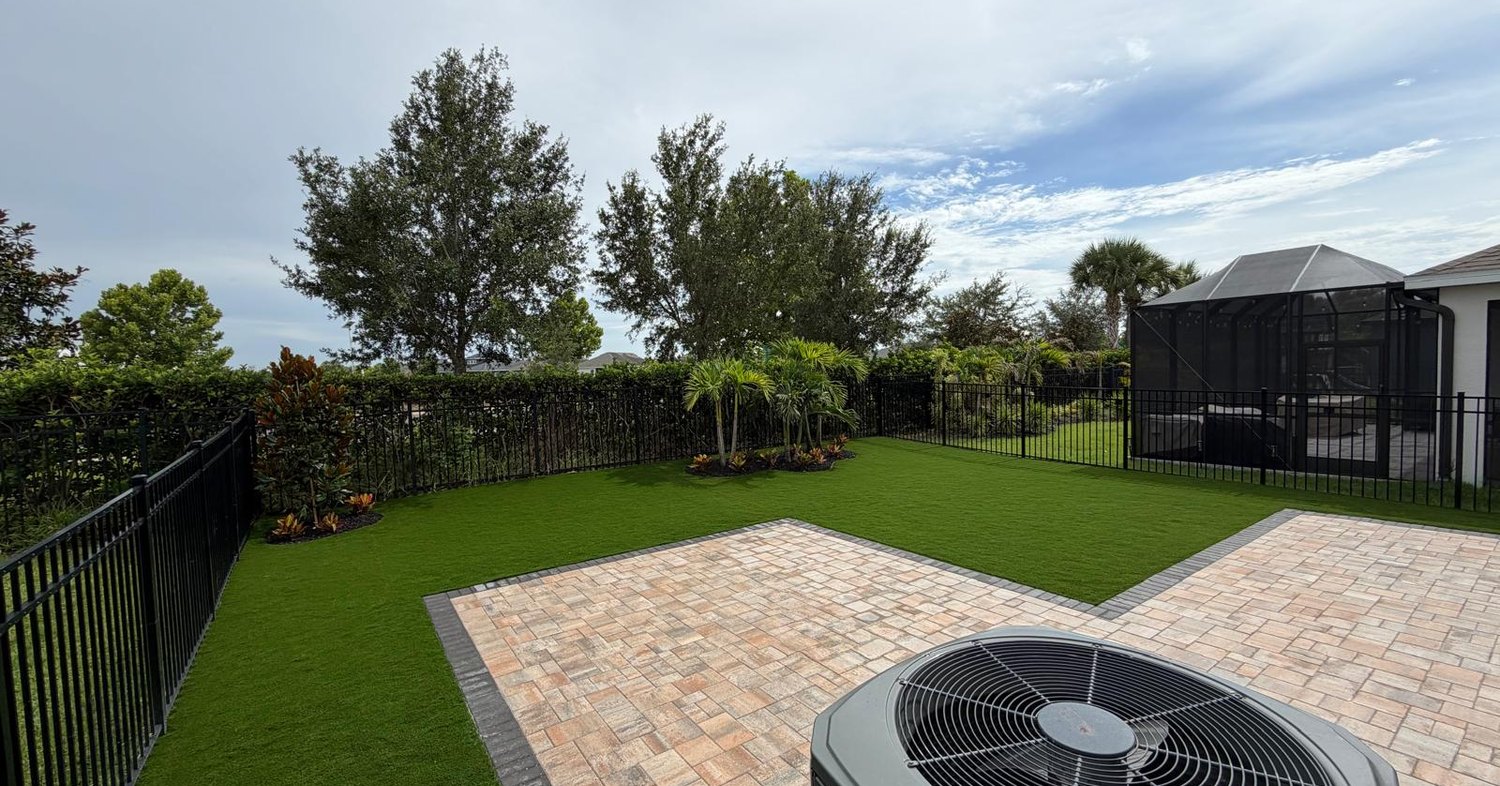
Coolest pavers for Florida patios matter most in Hillsborough County, where a pool deck sits in open sun from mid morning on. June alone averages 18.2 days at 90 F or hotter at Tampa International Airport. We have completed more than 2,000 projects across Florida, and heat underfoot is the first complaint we hear.
This guide walks the five decisions that actually do move surface temperature, in the order they matter. Every number below comes from a published measurement and we name the source. Choosing the coolest pavers for Florida sun is not a brand argument. It is reflectance, cement, finish, joint and shade.
Quick answer: The coolest pavers for Florida are light in field color, made with light cement and aggregate, finished with texture not polish, and shaded where you stand. Across 16 measured concrete paver samples, solar reflectance ran from 0.09 on black to 0.76 on white. Peak surface temperature falls about 9 F for each 0.1 gained.
Table of Contents
Why Color Decides The Coolest Pavers For Florida
Color is not decoration on a Florida pool deck. It is the one heat control you choose at the counter, and nothing else moves temperature as much. Pomerantz and others determined experimentally in 2003 that the peak surface temperature of cement concrete paving dropped about 5 C for every increase of 0.1 in solar reflectance, a result reported in the 2015 ICCBP paper on the Solar Reflectance Index. Five degrees Celsius is roughly 9 F.
The Heat Island Group at Lawrence Berkeley National Laboratory shows the same effect outdoors. In an infrared image they measured a light section of pavement about 30 F cooler than the dark section beside it. That figure describes pavement, and we quote it that way instead of turning it into a paver promise. It is still why the coolest pavers for Florida get picked by reflectance first.
Pick One: Light Colored Patio Pavers In The Field
Light colored patio pavers are the first pick because the field, the large area you walk on, sets the average temperature of the whole deck. The ICCBP study measured 16 concrete paver samples. Solar reflectance ran from 0.09 on the black sample to 0.76 on the white one, with thermal emissivity between 0.92 and 0.95. The white paver returned an SRI of 95, red pavers measured 0.24 to 0.31 with SRI values of 27 to 35, and the black paver came in at SRI 7.
Apply the published 9 F per 0.1 relationship across that span and the implied gap is very large. We call that an extrapolation from a measured relationship, not a temperature anyone recorded. Keep dark units for borders and accents, and put light colored patio pavers where feet land. That is where the coolest pavers for Florida earn their keep.
Pick Two: The Mix Behind Heat Reflective Pavers
Heat reflective pavers are not a product line, they are a mix. The Portland Cement Association measured the pieces separately and found that the solar reflectance of the cement affects the reflectance of finished concrete more than any other constituent material. White cement measured 0.87, gray cements 0.36 to 0.47, and slag cements 0.71 to 0.75. Fine aggregates ran 0.22 to 0.42 and coarse aggregates 0.27 to 0.42, all read with a portable solar reflectometer under ASTM C1549.
Two rules fall out of that. A pale face over a gray cement body does less than a light body does, so ask what the unit is made of. Reflectance also climbs while the cement hydrates, then stabilizes within six weeks of casting, so judge a cured sample. Belgard is the line we specify on a Florida paver patio, and it publishes no SRI value, so we never quote one.
Picks Three And Four: Finish And Joint
A cool deck surface is finish and geometry, not color alone. Texture scatters light and breaks the contact patch under a foot, so a tumbled or shot blast face reads better barefoot than a dense polished face in the same shade. Slip resistance moves with it. ANSI A326.3 sets 0.42 DCOF as its only numeric minimum, for interior dry and interior wet, and for exterior wet the standard asks the manufacturer to declare a value rather than fixing one. The static test ASTM C1028 was withdrawn in 2014.
Four things we check on a sample board before we call anything the coolest pavers for Florida:
- Field color first, borders and accents second.
- A textured face rather than a polished one.
- Joint sand color, since dark joints heat the gaps between units.
- Slope, at a typical 2 percent minimum, so the deck sheds our 49.48 inches of rain.
Reading The Numbers In Hillsborough County
The burn literature deserves a calm reading. Moritz and Henriques reported in 1947, as cited by Kowal-Vern and colleagues in Burns and Trauma in 2019, that second degree burns followed contact at 44 C, or 111 F, for six hours, at 50 C, or 122 F, for 15 minutes, and at 60 C, or 140 F, for five seconds. That paper measured asphalt and sand peaking near 68 C, about 154 F.
Nobody stands on a deck for six hours, so the point is narrower than it looks. A dark surface can climb to temperatures where contact time stops being forgiving, and a lighter one hands that margin back. In Hillsborough County that margin is what a barefoot friendly pool deck buys, and it is why the coolest pavers for Florida sell themselves in July. Our pool patio paver ideas page shows the pattern built.
| Sample | Solar reflectance | SRI | Barefoot read |
|---|---|---|---|
| White concrete paver | 0.76 | 95 | Highest of the 16 samples |
| Red concrete pavers | 0.24 to 0.31 | 27 to 35 | Mid range, common field color |
| Black concrete paver | 0.09 | 7 | Lowest, so we keep it to borders |
| LEED v4 paving threshold | 0.28 aged, 0.33 initial | Not used; v4 asks reflectance | A fair floor to request |
Want the coolest pavers for Florida sun tested on your own deck? We bring samples to the site and lay them in your patio’s real sun before you commit. Call (813) 777-5665 for a free estimate within 24 hours.
Pick Five Is Shade, And How We Choose The Coolest Pavers For Florida
Shade beats material. The 2019 burn paper found that shade gave relief on every surface it tested except asphalt, and that is the honest ceiling on what any paver can do. A screened lanai over the seating area, or cover over the steps and the walk to the door, changes the surface your feet touch more than one shade of color does. We build the pool patio around the pool you already have. That is the shade half of the coolest pavers for Florida question.
Our selection is short. We pull two light options and a mid tone, set them on the deck, and read them at midday. LEED v4 and v4.1 ask paving materials for a three year aged solar reflectance of at least 0.28, or an initial 0.33 where no aged value is published. The older SRI threshold that still circulates came from LEED 2009 and no longer applies.
Ready to plan a barefoot friendly pool deck? We have built in Hillsborough County and Manatee County for over 15 years, we back the work with a 3 year warranty, and estimates land within 24 hours. Call (813) 777-5665 or use our Florida contact page.
Frequently Asked Questions
Are light pavers really 30 degrees cooler than dark ones?
Not as a paver claim. The Heat Island Group measured a light pavement section about 30 F cooler than the dark section next to it in one infrared image. For pavers, the citable relationship is about 9 F per 0.1 of solar reflectance.
What solar reflectance should I ask a supplier for?
LEED v4 and v4.1 ask paving materials for a three year aged solar reflectance of at least 0.28, or 0.33 initial where no aged value exists. That is a fair floor to request, and the measured white sample sat far above it at 0.76.
Does Belgard publish an SRI number?
No. Belgard is the line we specify in Florida, and neither Belgard nor Tremron publishes solar reflectance or SRI values in the technical documents available to us. A contractor quoting an SRI for those brands is quoting something the maker never published.
Are travertine and shellstone cooler than concrete pavers?
Both are popular premium pool deck materials in Florida, but no verified absorption, slip or surface temperature values are published for either that we would repeat. We judge them the way we judge concrete, by laying a sample in your own sun.
How hot can a dark surface actually get?
The 2019 Burns and Trauma paper measured asphalt and sand near 68 C, about 154 F. Moritz and Henriques placed a second degree burn at 60 C, or 140 F, in five seconds. Shade and color pull a cool deck surface back from that.
Planning A Cooler Pool Deck In Manatee County
Order of operations on a real job runs like this. Pick the field color, confirm the body of the unit is light and not only its face, choose a textured finish, keep the joint sand light, and put shade where you stand longest. A deck that ponds after a Tampa storm is a problem no color fixes.
We have completed more than 2,000 projects across Florida, we work through Hillsborough County and Manatee County, and financing runs through HFS Financial and Lyon Financial. Our Florida team will read the sun angles and show you the coolest pavers for Florida conditions on your lot.
Let us price the coolest pavers for Florida heat on your deck. Call (813) 777-5665, tell us your town, and we will send a free estimate within 24 hours with the field color, joint and shade worked out.