
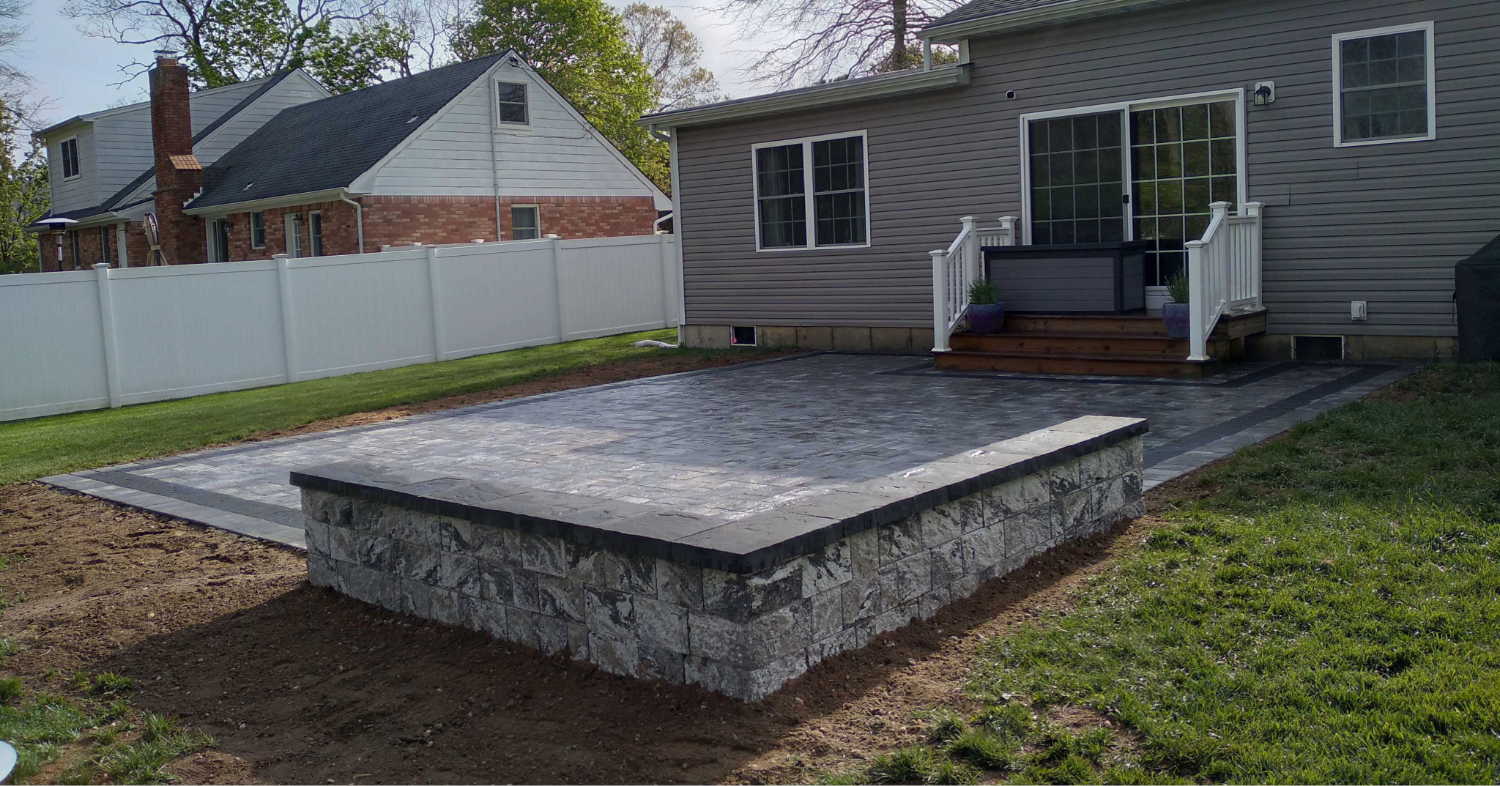
It is one of the first decisions New Hampshire homeowners face when planning an outdoor living space: concrete vs paver patio. Both are durable, widely used, and capable of looking beautiful. But they behave very differently, especially in New England’s climate, and the decision you make will shape how your outdoor space looks, functions, and holds up for years to come.
At Affordable Patio New Hampshire, we work exclusively with pavers and we are transparent about why. But in this article, we give you an honest look at both options so you can make the choice that is right for your property, your budget, and how you plan to use your outdoor space.
Table of Contents
- A Comparison Worth Making Carefully
- Understanding What Each Option Actually Is
- Durability and How Each Holds Up in New Hampshire
- Appearance and Design Flexibility
- Cost: Initial Investment vs Long-Term Value
- Maintenance Requirements Over Time
- Repair and What Happens When Things Go Wrong
- Which One Is Right for Your Situation?
- FAQs: Concrete vs Paver Patio
- Make the Decision with Confidence
A Comparison Worth Making Carefully
When homeowners start thinking about adding outdoor living space, the concrete vs paver patio question comes up quickly. Both options create a functional outdoor surface, both have their advocates, and both can look attractive when done well. The right choice, though, depends on factors that vary from one property to the next, and getting that decision right from the beginning saves real money over time.
At Affordable Patio New Hampshire, we specialize in paver installations, so we have a perspective here. But we also work with homeowners every day who come to us having already seen concrete bids, and we believe in giving people honest information rather than a sales pitch. This comparison is designed to help you think through the decision clearly.
A professionally installed outdoor living area is a top selling point; explore our custom patio services to boost your property value.
Understanding What Each Option Actually Is
Poured concrete is a monolithic surface, meaning the entire patio is one continuous slab. It is mixed, poured, and finished in one operation and then cures over several weeks. Decorative options like exposed aggregate, stamped patterns, or stained finishes can add visual interest, but they are all applied to that single solid surface.
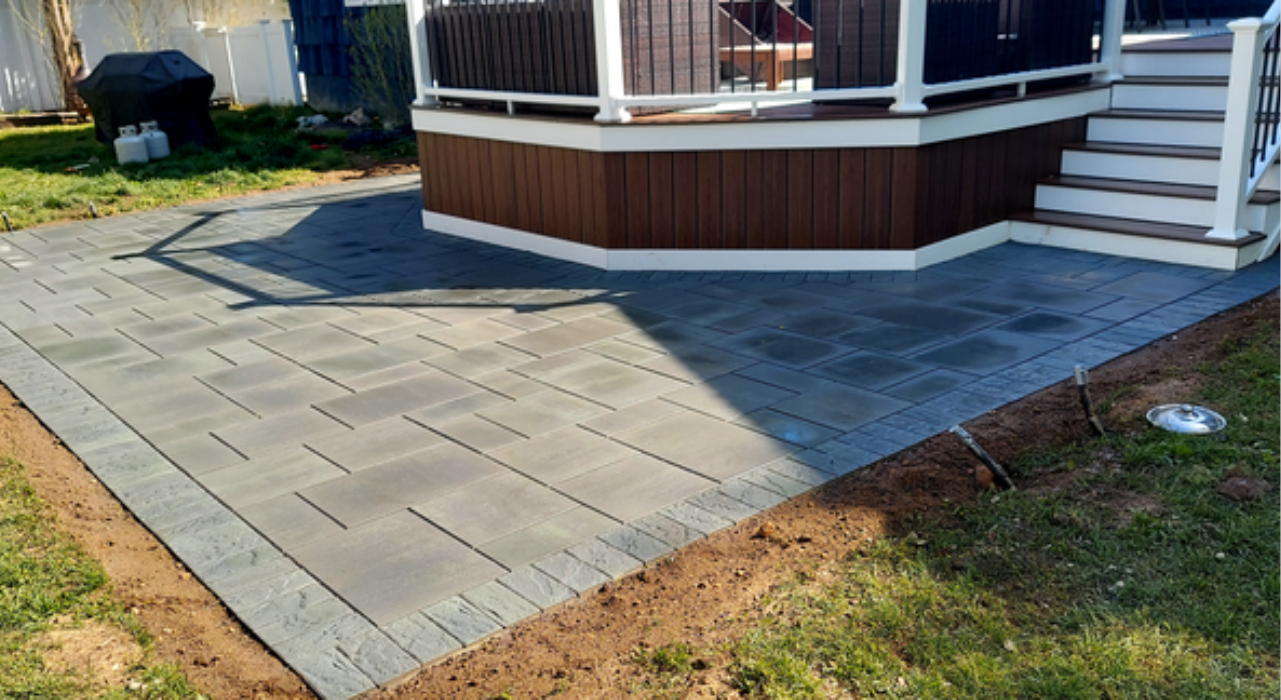
Paver patios are made of individual units, whether concrete pavers, natural stone, or brick, installed over a compacted granular base. Each unit is set separately and can be individually removed or replaced. The joints between units are filled with sand, typically polymeric sand, which provides a degree of flexibility the whole system lacks in a solid slab.
That difference in construction, monolithic versus modular, drives almost every other difference in performance, maintenance, and repair.
Durability and How Each Holds Up in New Hampshire
This is where the concrete vs paver patio comparison gets particularly relevant for New Hampshire homeowners. The freeze-thaw cycle is the dominant force acting on any outdoor surface in this region, and the two options respond to it very differently.
Concrete absorbs water into its surface. When that water freezes and expands, it creates internal stress within the slab. Over repeated cycles, this produces cracks, scaling, and spalling on the surface. The problem is compounded by road salts and deicers, which are corrosive to concrete and accelerate surface deterioration. Most concrete patios in New Hampshire show visible surface damage within five to ten years.
Pavers handle freeze-thaw movement differently. Because the installation is modular rather than monolithic, slight ground movement does not crack the surface. The individual units move independently, and the flexible base system accommodates minor shifts without visible damage. Well-made concrete pavers also have a lower absorption rate than poured concrete slabs, which means less water penetrates the surface to freeze.
Over a twenty-year time horizon in New Hampshire’s climate, paver patios consistently outperform poured concrete on durability, particularly in resistance to frost heave and surface degradation.
Appearance and Design Flexibility
Concrete offers a clean, uniform look that suits certain architectural styles well. Stamped concrete can mimic stone or brick patterns, and staining adds color variety. The limitation is that once the concrete is poured and cured, major design changes are not really possible.
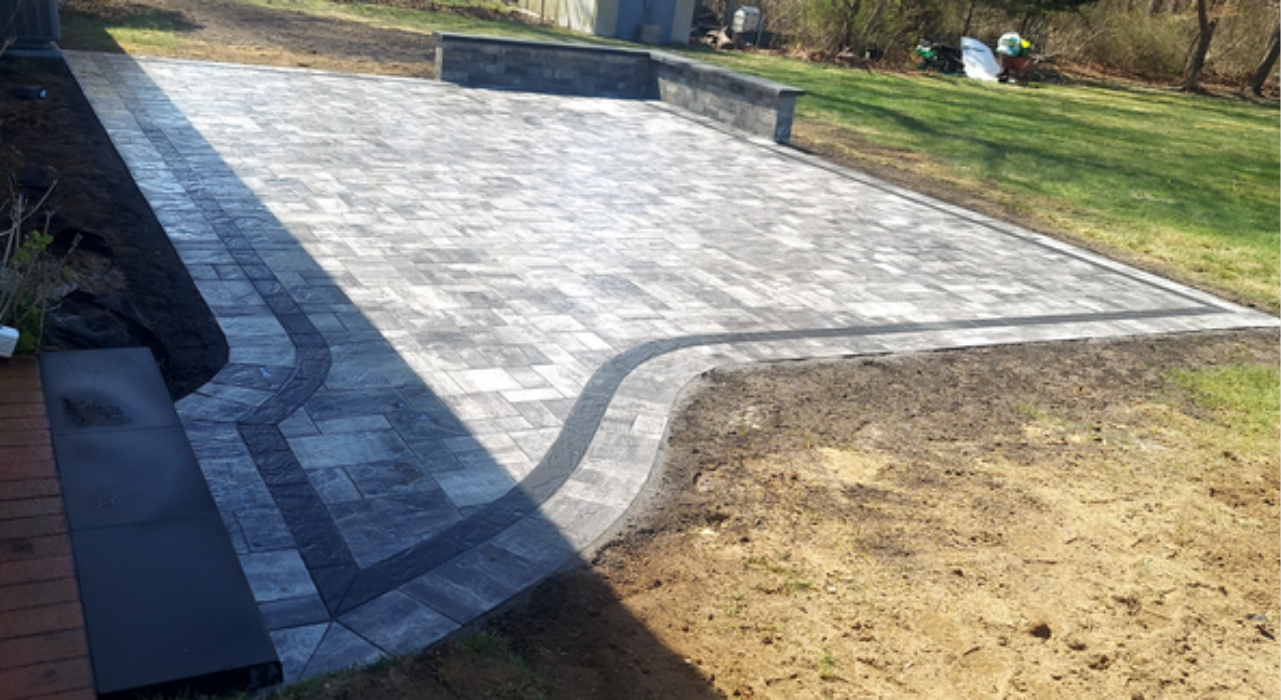
Pavers offer considerably more design flexibility. Different shapes, sizes, colors, and textures can be combined within a single installation. Borders, patterns, insets, and transitions between areas are all achievable in ways that poured concrete cannot match. For homeowners who want a distinctive outdoor space rather than a standard utilitarian surface, pavers typically give more design latitude.
Over time, paver colors weather naturally and can be refreshed with sealer. Stamped concrete, by contrast, requires periodic resealing to maintain its appearance, and if the surface is damaged, matching the original color and stamp pattern for repairs is often difficult.
Cost: Initial Investment vs Long-Term Value
Poured concrete is typically less expensive upfront than a paver patio of the same size. That is a real consideration, and we do not dismiss it. For homeowners on a tight budget who need functional outdoor space quickly, concrete can be a reasonable choice.
The long-term cost picture is more complicated. Concrete patios in New Hampshire almost always require significant maintenance or resurfacing within ten to fifteen years. Crack repair, resealing, and eventual replacement add up. Pavers have a higher initial cost but rarely require major intervention when properly installed. Individual pavers that shift or crack can be reset or replaced at minimal cost without disturbing the rest of the installation.
The total cost of ownership over twenty years, accounting for likely maintenance and repair, often favors pavers in climates like New Hampshire’s. That is not true in every region, but in a freeze-thaw environment, the math tends to lean in that direction.
Investing in your home is simple when you use our instant build and price tool to plan your budget.
Maintenance Requirements Over Time
Both surfaces require some maintenance, though the type differs.
Concrete needs periodic resealing, typically every two to three years, to protect the surface from moisture infiltration and staining. Cracks need to be filled promptly before water infiltrates and expands them. If the surface was stamped or stained, maintaining the visual consistency requires matching products and careful application.
Paver patios need joint sand replenishment periodically, as rain and traffic gradually displace sand from the joints over time. Polymeric sand holds up much longer than regular sand and reduces this maintenance interval significantly. Any individual paver that settles or shifts can be lifted, the base corrected, and the paver reset, a repair that takes minutes and does not affect surrounding pavers.
Repair and What Happens When Things Go Wrong
This is perhaps the starkest difference in the concrete vs paver patio comparison. Concrete, being monolithic, does not offer graceful repair options. A crack that runs through the slab is either lived with, filled with filler that never quite matches, or addressed through full or partial slab replacement. Large repairs require breaking out sections of concrete, a disruptive and costly process.
Paver repairs are fundamentally different. If a paver cracks, it is removed and replaced with an identical unit. If a section settles, the pavers are lifted, the base is corrected, and the pavers are reset. The repair is localized to exactly the area that needs attention. The rest of the patio is undisturbed, and there is no patching visible in the finished surface.
This repairability is particularly valuable as a patio ages. A paver patio can be maintained and refreshed indefinitely. A concrete patio has a finite useful life before replacement is the only realistic option.
Which One Is Right for Your Situation?
If budget is the primary constraint and you need a functional outdoor surface quickly, concrete is worth considering. If you are prioritizing long-term durability, design flexibility, repairability, and performance in a freeze-thaw climate, pavers are the stronger choice for New Hampshire properties.
Most homeowners who go through this comparison carefully end up choosing pavers, not because they are more expensive, but because the performance case in this climate is compelling. The flexibility to repair, refresh, and even reconfigure the installation over time is a meaningful advantage for a permanent outdoor space.
Witness the quality craftsmanship that local buyers love by following our current patio projects in the area.
FAQs: Concrete vs Paver Patio
Does a paver patio add more home value than a concrete patio?
Generally, yes. Paver patios are perceived as a premium outdoor feature and tend to add more to perceived home value than basic concrete slabs. The design quality, durability, and curb appeal of a well-installed paver patio typically resonates more positively with buyers than a concrete surface, particularly one that is showing age.
Can concrete be poured over an existing paver patio, or vice versa?
Pouring concrete over pavers is not recommended. The uneven surface and flexible base of the paver installation do not provide a stable substrate for a concrete slab, and the result tends to crack quickly. Pavers can be installed over a sound concrete slab in some situations, provided the slab is in good condition and properly sloped for drainage.
How long does a concrete patio typically last?
In moderate climates, a well-installed concrete patio can last twenty-five to thirty years before major deterioration. In New Hampshire’s freeze-thaw environment, significant surface cracking and spalling often appear within ten to fifteen years, and full replacement may be needed within twenty years.
Are paver patios slippery when wet?
Most concrete pavers have a textured surface that provides reasonable traction when wet. Tumbled or brushed finishes increase traction compared to smooth-faced pavers. Natural stone, particularly polished varieties, can be more slippery and is generally not recommended for wet areas without appropriate surface treatment.
What is stamped concrete, and how does it compare to pavers aesthetically?
Stamped concrete uses textured molds pressed into fresh concrete before it cures to create patterns resembling stone, brick, or tile. It can be visually attractive when new, but it does not replicate the dimensional variation and authentic appearance of actual pavers. Over time, as the surface weathers and the color fades, stamped concrete tends to look less like stone than it did initially, while actual pavers maintain their character as they age.
Make the Decision with Confidence
The concrete vs paver patio decision matters, and it is worth spending time on. For most New Hampshire homeowners who want an outdoor space that holds up for decades without constant maintenance and repair, pavers are the answer we recommend based on real experience with both options in this climate.
At Affordable Patio New Hampshire, we would be glad to walk through your specific property, talk through your goals, and give you a clear picture of what a paver installation would involve and cost. If you are still weighing your options and want an honest conversation about what makes the most sense for your backyard specifically, our team is happy to walk through it with you. No pressure, no runaround. Call us at (603) 999-9696 or visit our contact page at affordablepatio.com to get started today.