
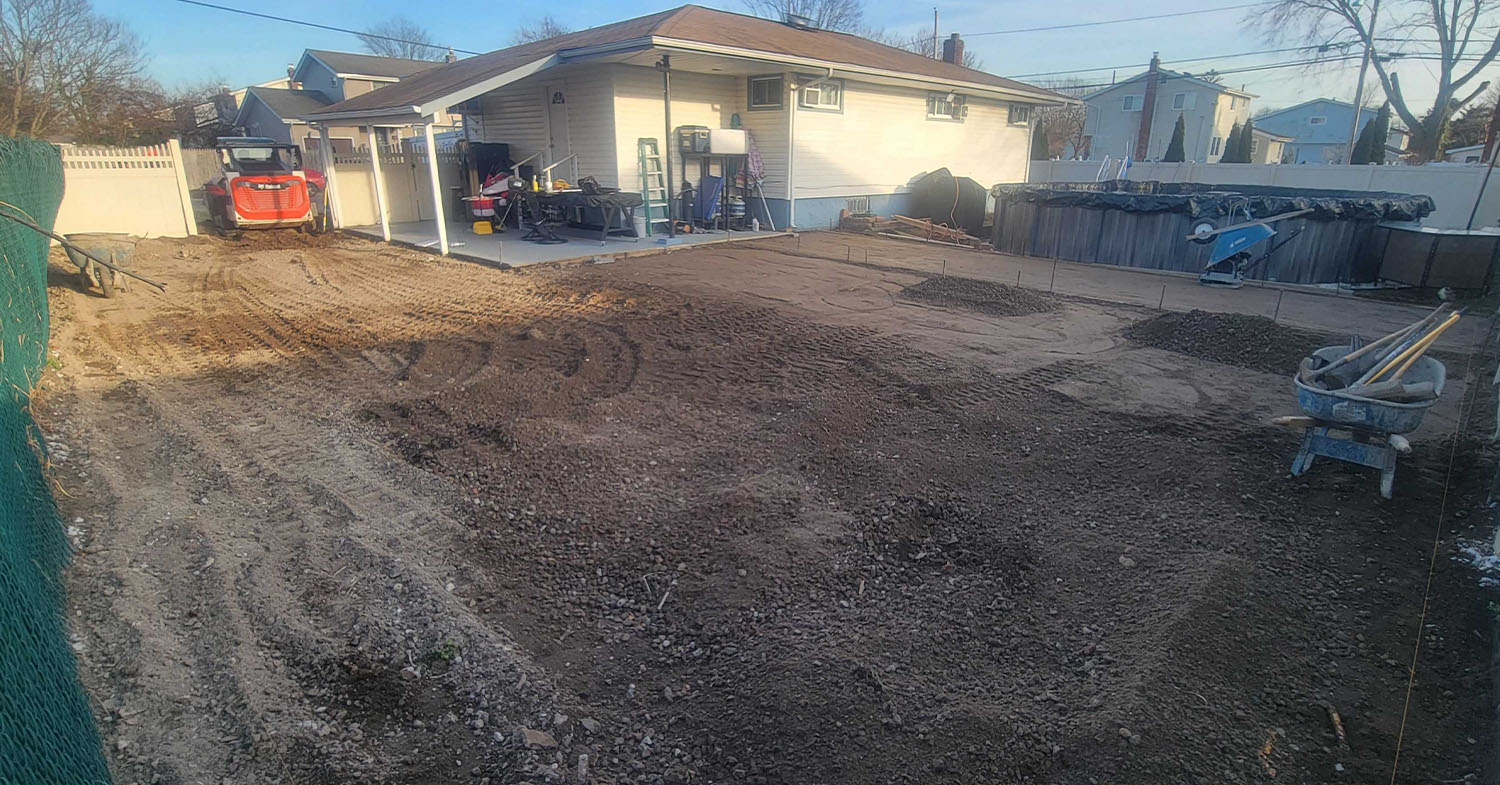
If you’re looking at your property and you’re excited to improve your backyard and create a place for your family’s best memories but you notice the ground is unlevel and you’re unsure if you can even put a patio there. This is a great question and we get it all the time because here on Long Island the properties are very rarely flat but we have a few solutions that would fix that problem and create a great living space that you and your family can use for years to come.
What if my property is unlevel or has a slope?
In 2026, we can easily build a patio on a slope that requires a “holistic” approach to structural integrity, as Long Island’s sandy soil can easily erode if a sloped patio isn’t properly retained. With over 3,100 projects completed, we prioritize technical soil stabilization and manufacturer-spec precision to ensure your raised or tiered patio remains perfectly level for decades.
Check out more about how to build a patio on a slope.
Solutions for Hilly or Uneven Yards
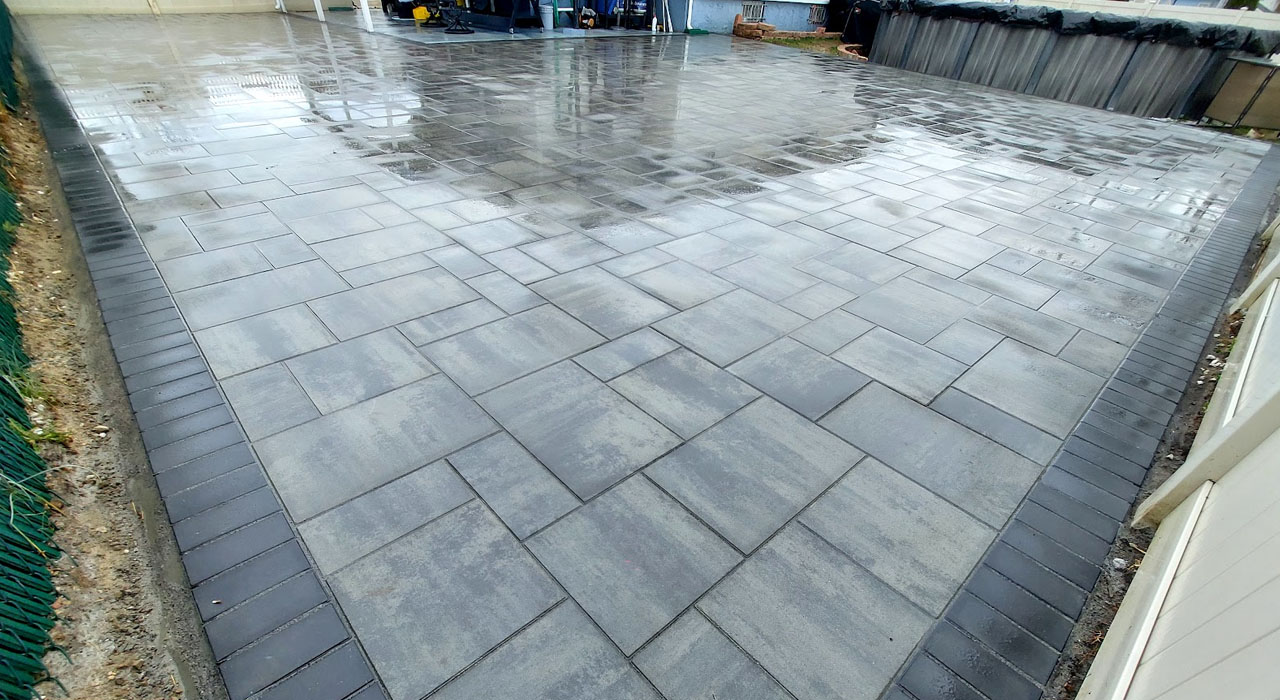
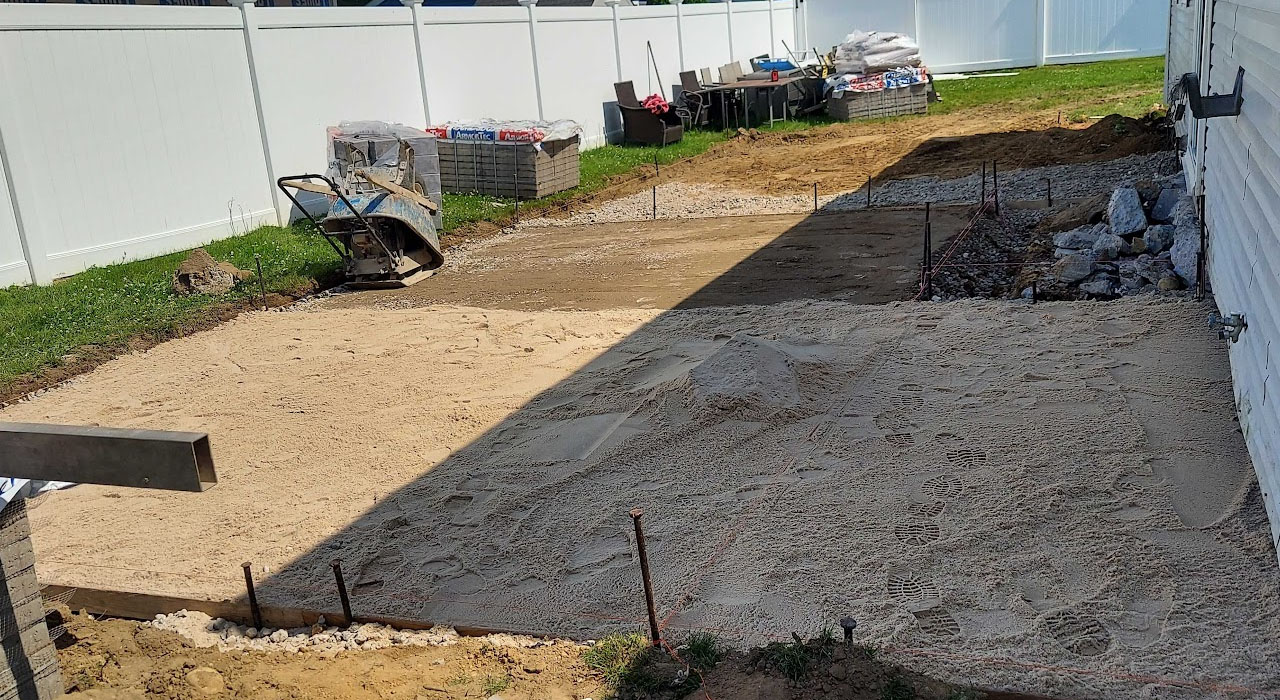
If you’re looking at your yard and notice it’s a little hilly or have bumps in the yard and you’re concerned about being able to build a patio on a slope in the area. Well this is not going to be a problem, when it comes installing a patio we will be excavating down 6 to 8 inches. This excavation is for the base and pavers this will allow us to make ground level for our application. The patio will always have a pitch to have the water exit the patio into the grass area. When we are setting the heights for the patio we will also look at the grade of your yard to use it to our advantage and sometimes pitch it to the grade of your yard. In some instances your patio may be a little higher than your grade. Which is okay because at this point we will use some of the existing soil or bring in new topsoil and put a gradual slope from the top of the patio to your grass.
Designing for Large Slopes: Steps and Tiers
When a yard has a significant slope, we use it to our advantage by creating a “multi-room” feel to build a patio on a slope that is both functional and beautiful.
- Integrated Steps: Instead of one massive, slanted area, we add steps in the middle or at the edge of the patio. This creates two or three distinct level living spaces—for example, a high-level dining area that steps down into a lower fire pit lounge.
- Functionality First: This tiered design doesn’t just look luxurious; it solves the elevation problem without requiring massive amounts of fill dirt.
Raising or Lowering the Grade
In some scenarios, we may recommend a more structural change to your property’s elevation to build a patio on a slope that offers lasting stability and beauty.
- Raised Patios & Retaining Walls: If you want your patio to stay high, we build a retaining wall around the perimeter. This holds the structure at the proper height and can be topped with a sitting wall to add character and extra seating.
- Lowering the Grade: If your property slopes toward the house, we can remove soil to “sink” the patio. We often add extra steps from your back door to reach this lower level grade. For instance, if you currently have 2 steps, we might install 4 steps to reach a flat, excavated area that would otherwise be an unusable hill.
Check out more about our Patio Installations:https://affordablepatio.com
Frequently Asked Questions
Will there be a water pool on my patio if it’s built on a slope?
Absolutely not. In fact, a slope can actually help with drainage when handled correctly. We engineer every patio with a specific “drainage pitch” of 1 inch for every 8 to 10 feet to build a patio on a slope that performs perfectly. This ensures that even during a heavy Long Island downpour, water moves efficiently off your masonry and into the designated lawn or drainage areas, protecting your home’s foundation from water intrusion.
Are retaining walls expensive to add to a sloped patio?
While a retaining wall does add to the initial cost, it is often the most cost-effective way to gain usable square footage in a hilly yard. By building a wall, we turn a “dead” hill into a functional, level “floor” for your outdoor life. This adds significant resale value to your property because it solves a landscaping problem that would otherwise limit the yard’s potential.
How do you ensure a raised patio doesn’t settle or shift over time?
For raised patios, we don’t just use dirt as fill. We use compacted RCA (Recycled Concrete Aggregate) in thin layers, vibrating each layer to maximum density. In New York’s climate, this is critical because it prevents the “voids” that lead to sinking during freeze-thaw cycles. Our technical approach ensures your raised masonry stays as solid as a foundation-built structure for the life of your home.
Can you match the steps to my existing house stone or siding?
Yes, we can. We offer a wide variety of Cambridge Pavingstones and cultured stones that can be customized to complement your home’s architecture. Whether we are adding steps to your back door or a tiered landing, we ensure the colors and textures blend seamlessly with your house, making the new masonry look like it was part of the original construction.
Bring Your Property to the Next Level
Thanks for reading! We hope this guide gave you the clarity needed to make the best choice for your home. We are dedicated to educating our clients so they can make informed decisions with confidence. If you’re ready to take your property to the next level, contact us today—we’ll send a trained estimator to explore your design options and provide a tailored solution for your specific needs. For any more information please call (631) 275-3142 or visit https://affordablepatio.com.