
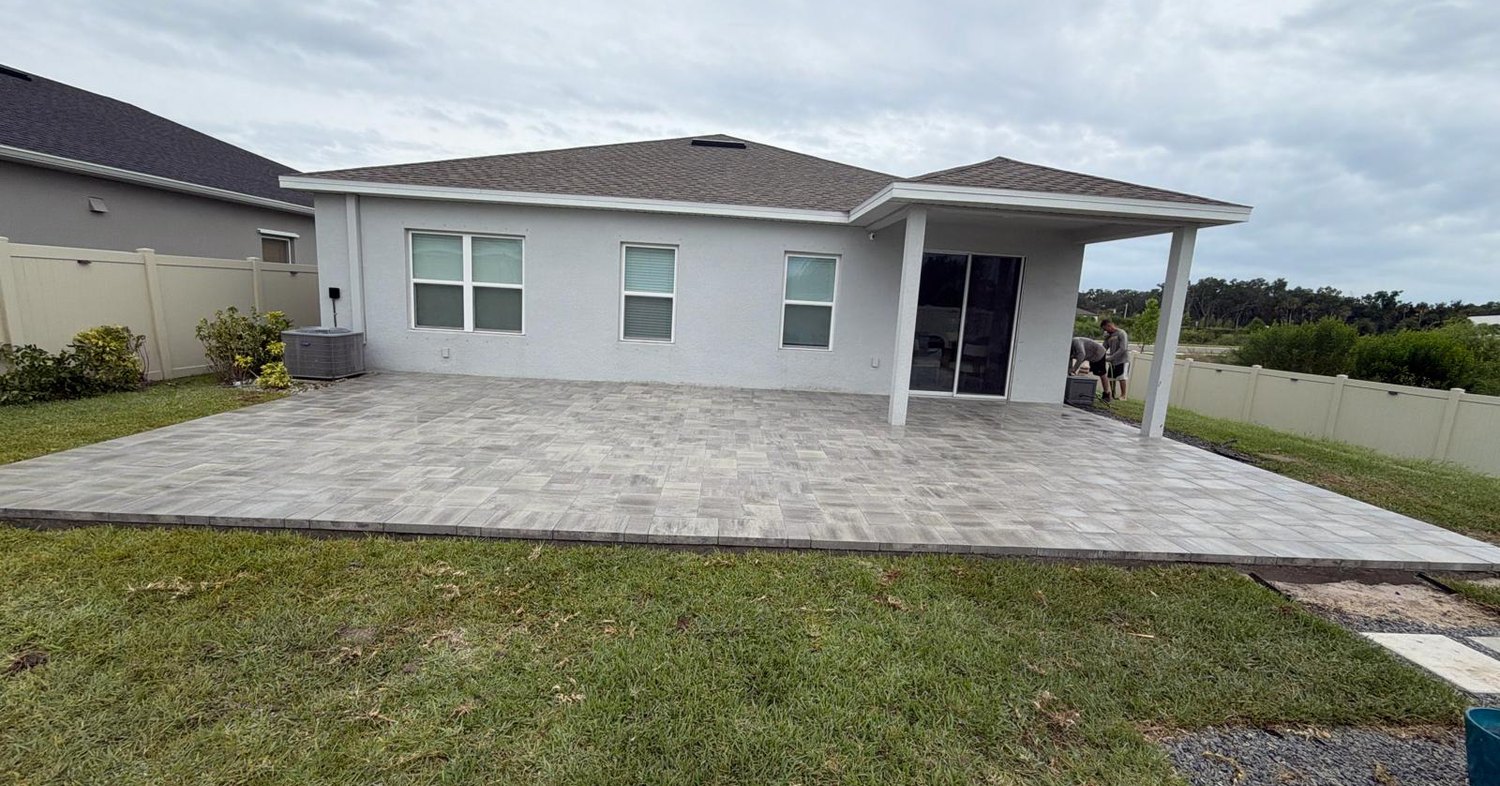
The best driveway material for Florida has to survive two things at once: surface heat that lasts most of the year, and 49.48 inches of normal annual rain measured at Tampa International Airport under the 1991 to 2020 normals. We have installed hardscape here for over 15 years, and the driveways that fail early almost never fail because of the paving unit itself.
This guide walks the four materials Florida homeowners actually choose between: concrete pavers, poured concrete, asphalt and shell. We give the specification behind each claim, we flag where a number comes from a highway spec instead of a residential one, and we skip numbers nobody has published. That is how we pick the best driveway material for Florida yards.
Quick answer: For most Hillsborough County and Manatee County homes, concrete pavers are the best driveway material for Florida heat and heavy rain. Joints move water, single units lift out for repair, and the base gets built for local soil. Poured concrete is the value option, asphalt runs darkest, and FDOT does not specify shell as a driving surface.
Table of Contents
Rain, Not Frost, Decides the Best Driveway Material for Florida
Northern driveway advice is built around freeze and thaw. Tampa Bay does not have that problem. The salt solution version of ASTM C1645 is a deicer test and describes nothing that happens in your yard. Water is what happens here. Tampa International Airport normals for 1991 to 2020 put annual precipitation at 49.48 inches, with 7.37 inches in June alone.
So driveway drainage Florida homeowners can live with is the first design decision, not the last. CMHA recommends a minimum slope near 2 percent on segmental pavement, and that grade has to run somewhere useful, not toward the garage door. We also watch joint sand. Once it sits more than half an inch below the paver surface, CMHA says replace it immediately, since that sand carries the interlock. The best driveway material for Florida is picked by how it handles water first.
Why Concrete Pavers Are the Best Driveway Material for Florida Homes
Florida driveway pavers are built to a real product standard. ASTM C936/C936M-24 requires an average compressive strength of at least 8,000 psi with no single unit under 7,200 psi, average absorption no higher than 5 percent with no unit above 7 percent, and length and width held to plus or minus one sixteenth of an inch. Belgard and Flagstone are the lines we work with here.
Repair is the trait homeowners underrate. CMHA describes segmental pavement as a zipper: units come out and go back without a jack hammer, so an underground repair or one settled corner never becomes a saw cut patch that will not match. That property is why we call concrete pavers the best driveway material for Florida driveways sitting over sandy soil.
Poured Concrete and the Concrete vs Pavers Florida Tradeoff
The concrete vs pavers Florida question turns on joints. Plain concrete shrinks as it cures, and restrained shrinkage cracks the slab. NRMCA CIP 6 sets control joint spacing at 24 to 36 times the slab thickness with a 15 foot maximum, landing near 10 feet on a 4 inch slab. ACI 302.1R uses the same multiplier under an 18 foot cap.
Depth and timing matter as much as spacing. NRMCA calls for a groove at least one quarter of the slab thickness and never under 1 inch, saw cut 4 to 12 hours after finishing. Poured concrete can still be the best driveway material for Florida budgets when those joints get cut on time. Our driveway pavers vs concrete comparison puts the two side by side.
Asphalt Runs the Darkest Surface in Florida Sun
Asphalt is the darkest of the four. The Heat Island Group at Berkeley Lab puts new asphalt at 5 percent solar reflectance and aged asphalt at 10 to 20 percent, against 30 to 50 percent for new cement concrete and 20 to 35 percent aged. In one infrared image the group measured a light pavement segment about 30 degrees Fahrenheit cooler than the dark segment beside it.
On softening we quote only the spec. FDOT Section 916, a highway specification and not a residential paving rule, calls for PG 67-22 binder in hot mix asphalt, and PG 67 is tested at 67 degrees Celsius, near 152.6 Fahrenheit, under AASHTO T 315. No source publishes one temperature at which a home driveway deforms. The NAHB life expectancy study gives asphalt 15 to 20 years.
What Shell and Coquina Really Are in Florida
Shell is the most misdescribed option in the state. FDOT Section 285 lists Shell Base, Shell Rock and Cemented Coquina at LBR 100 among optional base course materials, and Section 911 defines shell as naturally occurring deposits of broken mollusk shell, corals and the skeletal remains of other marine invertebrates, holding at least 50 percent carbonates.
Read that carefully, because it is a highway base specification. FDOT specifies shell as a base course under a pavement, and there is no FDOT specification for shell as a finished driving surface. Dredged shell also carries a gradation limit, 97 percent passing a three and a half inch sieve and no more than 7.5 percent passing the No. 200 sieve washed. A loose shell driveway migrates in heavy rain and needs topping up.
Base and Drainage Under the Best Driveway Material for Florida
Florida bases are genuinely different from northern ones. The FDOT optional base course list, again a highway specification, includes Limerock at LBR 100, Recycled Concrete Aggregate at LBR 150 and the shell materials, and bars RCA from interstate roadways. In the Flexible Pavement Design Manual, RCA and limerock both rate a 0.18 structural coefficient while graded aggregate rates 0.15.
For thickness, CMHA PAV-TEC-010 gives 6 to 8 inches of aggregate base under a residential driveway, 4 to 6 under a walk and 8 to 12 under a street. Our crews specify a 2 to 4 inch crushed concrete base for the soil we work in, which is our number and not the CMHA figure. Permeable pavement answers driveway drainage Florida lots need:
- Subgrade with at least 2 inches per hour of vertical saturated hydraulic conductivity.
- Seasonal high water table at least 2 feet below the bottom of the system.
- Full drainage within 24 to 72 hours, on a slope no steeper than 5 percent.
| Material | Heavy rain | Surface heat | Repair | Spec |
|---|---|---|---|---|
| Concrete pavers | Joints and base drain | Tracks unit color | Lift and reset | ASTM C936, 8,000 psi |
| Poured concrete | Sheds water on slope | Reflects 30 to 50 percent | Patch rarely matches | NRMCA CIP 6 joints |
| Asphalt | Edges ravel unsupported | Reflects 5 percent new | Overlay, seams show | FDOT highway spec 916 |
| Shell driveway | Migrates and rills | Light, loose underfoot | Rake and top up | FDOT 285 base course only |
Want the best driveway material for Florida spelled out for your lot? Call (813) 777-5665 and we will walk the grade, the soil and the water path, then put the base thickness in writing on a free estimate within 24 hours.
Thinking about Florida driveway pavers in Hillsborough County or Manatee County? We have built here for over 15 years, more than 2,000 projects across Florida, with a 3 year warranty. See our Florida driveway page or call (813) 777-5665.
Frequently Asked Questions
Which is the best driveway material for Florida heat?
Color drives surface heat more than material name. Berkeley Lab measured a light pavement segment roughly 30 degrees Fahrenheit cooler than the dark segment beside it, and new asphalt reflects only 5 percent of sunlight. A lighter concrete paver is the cooler practical pick.
Is a shell driveway approved in Florida?
FDOT recognizes shell, shell rock and cemented coquina as optional base course materials at LBR 100 under Section 911. There is no FDOT specification covering loose shell as a finished driving surface, so treat that use as a landscape decision rather than a paving standard.
How does material choice change driveway repairs?
Pavers lift and reset without a jack hammer, which CMHA calls a zipper in the pavement. Poured concrete needs saw cutting and a patch that seldom matches the original pour. That gap drives most of the concrete vs pavers Florida decision after year five.
Do I need a permit for a driveway in Tampa?
The City of Tampa issues its own residential driveway permit, and the process names pavers directly: if the driveway will be constructed using paver blocks, a paver edge detail may be required on the plan. Tampa also asks you to identify every tree within 20 feet.
How much rain does driveway drainage Florida design handle?
Tampa International Airport normals for 1991 to 2020 show 49.48 inches of precipitation a year, and 7.37 inches in June alone. CMHA recommends roughly 2 percent minimum slope on segmental pavement, plus inspection during or immediately after a rain twice a year.
Choosing the Best Driveway Material for Florida in Hillsborough County
Permits are the last item to check when you install the best driveway material for Florida, and the easiest to skip. In unincorporated Hillsborough County the county list of exempt work does not include paver patios or paver driveways, so confirm with Development Services at (813) 272-5600. The City of Tampa is more explicit, since it issues a residential driveway permit and asks for assumed elevations on a 25 foot grid.
Florida has no state license category specific to paver installation, and Hillsborough County does not list one locally. Ask any bidder for a license number and verify it at myfloridalicense.com. Our Florida team handles layout, base and permits together, and Florida driveway pavers are what we install most.
Let us price the best driveway material for Florida conditions at your address. Call (813) 777-5665 or use our Florida contact page, and your free estimate arrives within 24 hours with the base specified in writing.