
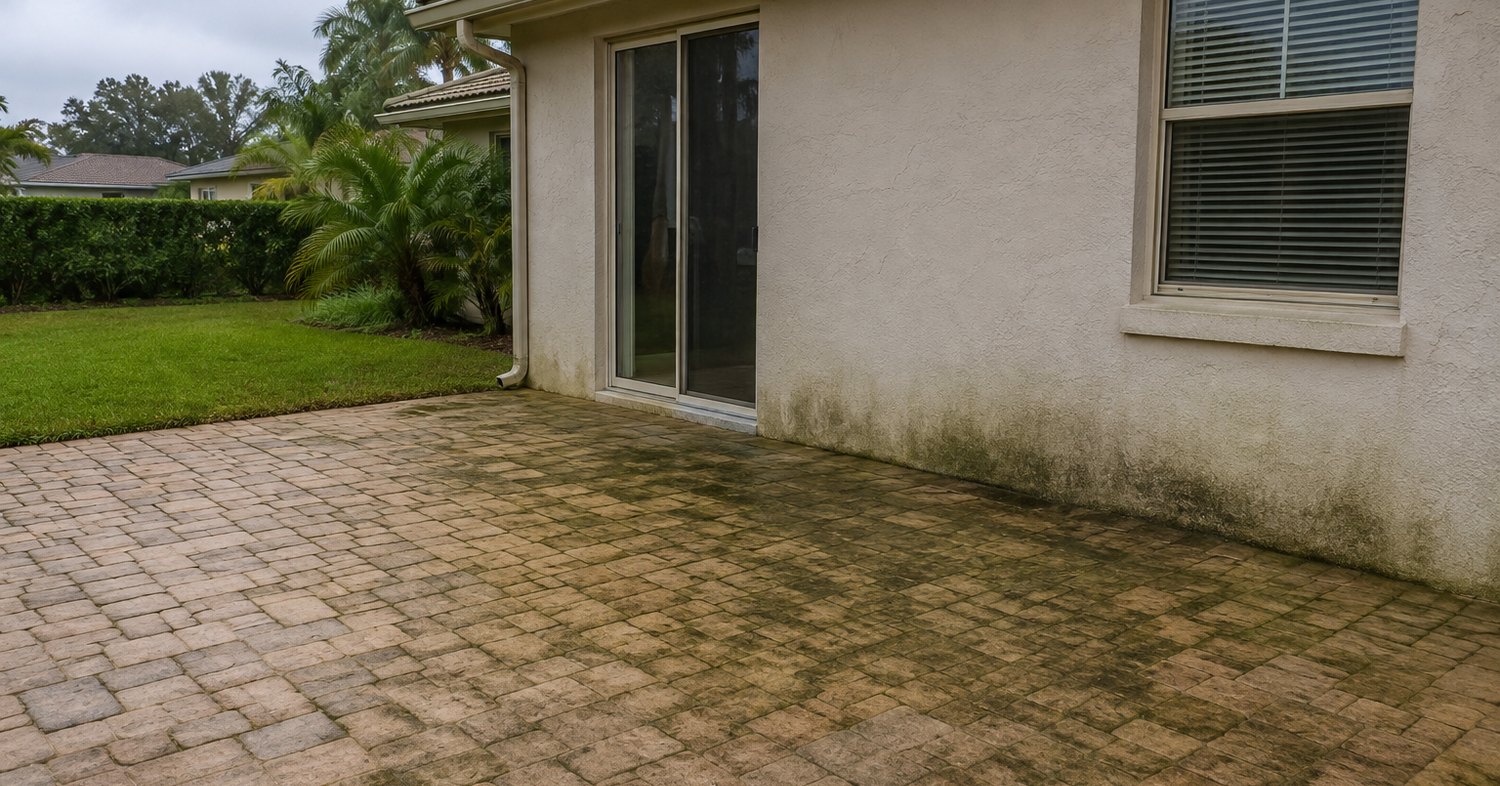
Algae on Florida pavers is the call we take most often in Hillsborough County once the summer rain settles in. A green film spreads over the shaded half of the patio, someone slips, and the phone rings. We have completed more than 2,000 projects across Florida, and the answer is rarely a stronger chemical.
This guide names what is actually growing, separates it from the white haze that is not mold at all, and gives prevention that holds up in this climate. We label every source, because the biology here is easy to get wrong. Algae on Florida pavers is a maintenance problem you can win.
Quick answer: Algae on Florida pavers is the slimy green film, and it is the real slip hazard. Fuzzy dark patches are mold or mildew. UF/IFAS Extension puts mildew growth at its best between 77 and 86 F, while Tampa’s normal annual mean is 74.5 F. Cut shade, fix drainage, keep the surface dry.
Table of Contents
What Algae on Florida Pavers Actually Is
Five different things grow on paving and they are not interchangeable. A technical note from PROSOCO, which is a manufacturer and should be read as one, sorts them cleanly. Molds, mildews and yeasts are green, brown or black and develop a fuzzy layer. Algae are green, red or brown and often look slimy. Lichen is algae and a fungus growing together, usually orange or gray. Moss forms dense green clumps or mats. Ivy climbs with aerial roots or small suction pads.
That same manufacturer note lists the damage. Growth holds water against the surface, its acidic byproducts lower pH, lichen shrinkage puts shear stress on the face, and it can pit, discolor and dissolve calcium carbonate. When homeowners search for green mold pavers, what they usually have is algae, and algae is the one that puts somebody on the ground.
Why Tampa Bay Humidity Feeds Mildew on Patio Surfaces
Here is the number that explains your patio. UF/IFAS Extension describes mildew as a mold that attacks cellulose and lignin, growing best between 77 and 86 F, needing moist warm air, and thriving in dark places where there is not much air circulation. Hold that range against National Weather Service normals for Tampa International Airport: a normal annual mean of 74.5 F, and a normal June mean of 82.9 F. June sits inside the optimum.
Add 49.48 inches of normal annual rainfall, 7.37 inches of it in June, and the condition list is satisfied for months. June alone brings a normal 18.2 days at 90 F or higher. Algae on Florida pavers follows the same curve. The humidity paver stains we get called about are not bad luck, they are the default outcome wherever a surface stays shaded and damp in Hillsborough County.
Five Prevention Steps for Algae on Florida Pavers
UF/IFAS puts the strategy in one line: keep things clean, dry, cool and with good air circulation, and prevention is the best way to control mildew. Oregon State University Extension names the contributing conditions on hard surfaces as debris buildup, poor drainage, overhanging branches that cast shade, and high moisture retention. Those sources give the five steps we use on algae on Florida pavers.
- Open the shade. OSU Extension says to remove or thin overhanging branches and vegetation that shade the surface. Sun and moving air dry pavers before growth takes hold.
- Clear the debris. Leaves and needles hold moisture and feed growth, so blow the surface clean instead of letting a wet mat sit.
- Correct the water. Standing water is the whole problem, and it gets the next section.
- Put it on a calendar. OSU Extension calls annual maintenance essential, and CMHA recommends preventive paver maintenance twice a year.
- Protect the joints. Joint sand stabilization secures the sand and reduces its removal by flowing water, wind, aggressive cleaning, tire action and organic matter.
Drainage And Slope In Hillsborough County Backyards
UC IPM, the University of California statewide pest program, makes the point that ties it together: abundant algae and moss sometimes indicate that soil drains poorly. That is the sentence we quote to homeowners who have scrubbed one corner four times. If growth returns in one spot and nowhere else, the problem is usually not your cleaning routine. Moss prefers partly shaded locations, which is why the north side of a house shows it first.
CMHA recommends a typical minimum slope of 2 percent. Under 49.48 inches of annual rain, a flat panel holds a film of water for hours after every storm, and algae on Florida pavers needs nothing more than that. UC IPM also notes growth on hardscape is slippery, unsightly and unsafe for walking. We start a paver patio evaluation with a level, not a pressure washer.
Paver Cleaning Florida Homeowners Can Do Without Losing Joint Sand
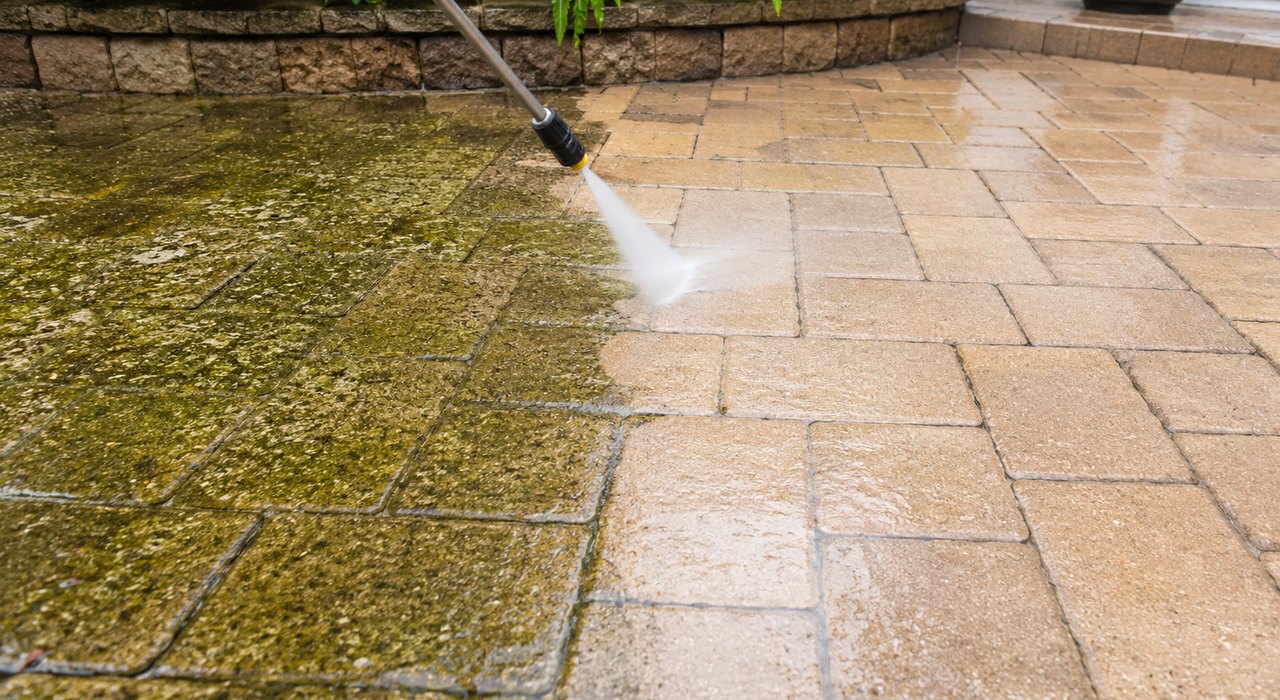
Start with what is published. CMHA, the trade association behind the paver installation standards, states that a high pressure sprayer applies cleaner and water between 1,000 and 4,000 psi at 2 to 6 gallons per minute. A wide spray nozzle prevents sand from being washed out of the joints, and a low angle of attack reduces the risk of dislodging joint sand. Cleaners go on at low pressure, 30 to 100 psi.
Two honest gaps belong in any paver cleaning Florida guide. CMHA publishes no stain table row for moss, algae, mold, mildew or fungus, and nobody authoritative publishes a psi number above which a paver face is damaged. What is published is the cost of getting algae on Florida pavers wrong: joint sand can be lost to pressure washing, and if sand has dropped more than half an inch it must be replaced immediately.
| Growth | How it looks | Risk | Do | Do not |
|---|---|---|---|---|
| Algae | Slimy green, red or brown | Slip hazard | Dry it out, fix slope | Blast the joints open |
| Mold or mildew | Fuzzy green, brown or black | Stains, holds moisture | Open shade, move air | Let debris sit |
| Lichen | Orange or gray crust | Slow, mostly cosmetic | Remove where you walk | Panic, it is harmless |
| Moss | Dense green clumps or mats | Slippery when wet | Read it as drainage | Scrape and wait |
| Efflorescence | Whitish powdery deposit | None to the paver | Use an efflorescence remover | Treat it as mold |
Not sure whether you have algae on Florida pavers or a drainage defect? We check slope, joint sand depth and where the water goes before anyone talks about paver cleaning Florida patios need. Call (813) 777-5665 for a free estimate within 24 hours.
White Haze, Sealers And What Is Not Established
The white film on a new patio is efflorescence, not growth. Curing cement releases calcium hydroxide, which is water soluble, travels up by capillary action, and reacts with carbon dioxide to leave calcium carbonate. CMHA says it can peak in as little as 60 days after installation and does not affect the structural performance or durability of concrete pavers. Those humidity paver stains wash off and fade on their own. Mildew on patio pavers does not behave that way.
On sealers, watch who is talking. CMHA claims sealers stop weeds, seeds and ants and reduce water passing through the joint sand. It makes no claim that a sealer reduces algae on Florida pavers, mold or moss. The claim that a water repellent greatly reduces future biological growth comes from a sealer manufacturer, not from the standards body. Read the CMHA cleaning and sealing guidance yourself.
Book the walkthrough before the next rainy season. We look at grade, joints and shade on pool patios across Hillsborough County and Manatee County, then price only what changes the outcome. Call (813) 777-5665 for a free estimate within 24 hours.
Frequently Asked Questions
Is the green film algae or mold?
Almost always algae. A manufacturer technical note describes algae as green, red or brown and often slimy, while molds and mildews grow a green, brown or black fuzzy layer. People search for green mold pavers, but the slimy film is algae.
Will a sealer stop algae on Florida pavers?
Not according to the standards body. CMHA limits its published sealer claims to weeds, seeds, ants and reduced water penetration through the joints. The claim that a water repellent reduces biological growth is a manufacturer claim, not an established finding.
Can I use bleach on my patio?
UF/IFAS lists household bleach for mildew work and warns you to protect plants from these chemical mixtures. A manufacturer note advises against bleaches, saying they leave residues, stain and lighten masonry. No authoritative comparison of sodium hypochlorite against oxygen bleach exists.
What about pressure washer runoff?
Worth knowing first. Manatee County stormwater runs under Ordinance 00-02 and an MS4 permit, and discharges to the storm sewer other than storm water flows are generally prohibited, with fines to $2,000 per day. Whether wash water qualifies is not settled publicly.
How often should I clean my patio?
CMHA recommends preventive maintenance twice a year, with an inspection in spring during or right after a rain and another in late summer or early fall. That rhythm catches mildew on patio surfaces while a light rinse still removes it.
Keeping Algae on Florida Pavers Under Control In Hillsborough County
UF/IFAS EDIS publication EP485 explains that lichens are a fungus and an alga or cyanobacteria in a mutually beneficial relationship, that they do not harm the plants they grow on, and that the best strategy is to leave them alone. We still remove them from walking surfaces, because UC IPM is clear that hardscape growth is unsafe.
We have installed Belgard and Flagstone work for over 15 years, back it with a 3 year warranty, and our Florida team would rather correct the grade once than clean a corner yearly.
Ready to stop fighting algae on Florida pavers every summer? Call (813) 777-5665 or use our Florida contact page, and we will read your slope and drainage in Hillsborough County and send a free estimate within 24 hours.