
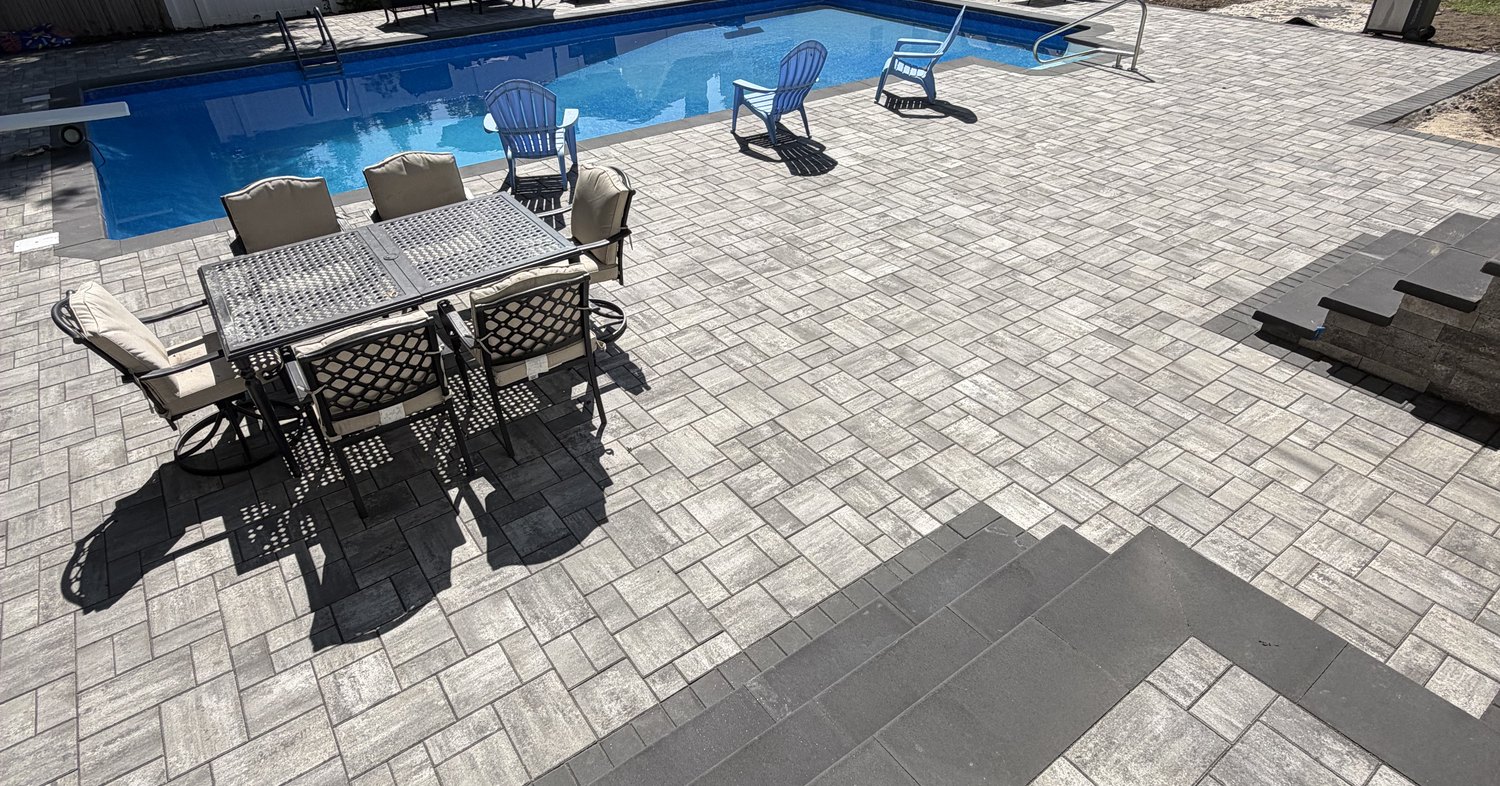
Slip resistant pool patio pavers are the one upgrade Long Island homeowners feel with bare feet every summer. A pool deck stays wet, bakes in the sun and gets crossed by kids who run. The surface either grips or it does not, and that difference is measurable, not a matter of taste.
We build pool decks across Suffolk County and Nassau County, and the question we hear most from parents is simple: will this get slippery? This guide answers it with the standard that governs a barefoot outdoor surface, and shows what to ask before you buy slip resistant pool patio pavers.
Quick answer: Slip resistant pool patio pavers should be specified against ANSI A326.3, which sets a minimum wet DCOF of 0.55 for exterior wet surfaces. A residential pool deck is an exterior wet barefoot surface, so 0.55 is the number that matters, not the 0.42 quoted for interiors. Ask for the technical data sheet with the tested DCOF.
Table of Contents
Why Slip Resistant Pool Patio Pavers Matter Around Long Island Pools
A pool deck is the wettest walking surface on any property. Water sheets off swimmers, sunscreen lands on the same stones, and the traffic is barefoot and fast. Pool patio safety is decided by that surface long before anyone thinks about posting a rule. Slip resistant pool patio pavers cut risk in the exact condition where a smooth stone fails, which is a thin film of water on a slight slope.
Long Island adds its own load. The Islip MacArthur station records 45.99 inches of precipitation a year, so a deck that drains slowly holds water long after swimming ends. Add 31.8 inches of average annual snow and freeze thaw cycling, and grip treatments painted on afterward have a short life. That is why our pool patio installation work starts with texture built into the unit rather than a coating added later.
Wet Paver Traction and What ANSI A326.3 Actually Requires
DCOF stands for dynamic coefficient of friction, and under ANSI A326.3 it is measured wet. That is the point. Wet paver traction is what the method captures, using a standardized sensor pulled across a wetted surface at a controlled speed.
The 2022 edition sets minimums by use situation. Interior dry is 0.42 and interior wet is 0.42. Interior wet plus, which covers barefoot areas, is 0.50. Exterior wet is 0.55, and so is any surface exposed to oils and greases. A residential pool deck sits outdoors, gets wet on purpose and is walked barefoot, so slip resistant pool patio pavers belong at 0.55, not at the 0.42 repeated on interior tile pages.
The standard also warns that a number alone is not enough. Use, traffic, contaminants, maintenance and wear all change how wet paver traction holds up after a few seasons.
| Use situation | Minimum wet DCOF | Where it applies |
|---|---|---|
| Interior, dry | 0.42 | Indoor floors kept dry |
| Interior, wet | 0.42 | A mudroom or laundry entry |
| Interior, wet plus (barefoot) | 0.50 | A shower room floor |
| Exterior, wet | 0.55 | Pool decks, coping, patios, steps |
| Oils and greases | 0.55 | The floor under a grill |
Not sure what your deck is rated at? Send us the paver name and we will pull the technical data sheet and read the tested DCOF with you. Free estimates across Suffolk County come back in 12 to 24 hours. Call (631) 275-3142.
How Texture and Joints Build a Non Slip Pool Deck
Finish is where marketing gets loose. A tumbled edge, a shot blast face and a textured top all read as grippy in a showroom, yet none carries a published DCOF. Slip resistant pool patio pavers earn the name product by product, so ask for the data sheet covering the exact paver, color and finish.
Three things genuinely help, and you can judge each by hand:
- A textured or slightly open face breaks the film of water underfoot.
- A chamfered or rounded edge gives the foot a defined step, not one flat plane.
- Sanded joints every few inches interrupt a continuous wet surface the way a slab cannot.
A non slip pool deck also depends on what happens after the crew leaves. Joint sand that washes out leaves ridges, and an unwashed deck builds a film of sunscreen and algae that lowers grip.
Textured Pool Coping and the First Step Out of the Water
Coping is the piece people grab and the piece they step onto with dripping feet. It stays wet longer than the rest of the deck every time the pool is used, which makes it the highest risk square foot in the yard. Textured pool coping deserves to be specified deliberately.
A bullnose profile sheds water off the edge instead of holding it against the pool wall. Coping set slightly proud of the deck gives a tactile cue right at the edge, which matters for children and for anyone climbing out backwards. Our guide to pool coping for Suffolk County homeowners covers the profiles.
Hold the edge to the same 0.55 threshold as the field. Slip resistant pool patio pavers lose their advantage if the coping beside them is smoother, and requesting the data sheet on textured pool coping takes one email to the supplier.
Color, Heat and Pool Patio Safety on Long Island
Surface temperature belongs inside the pool patio safety conversation rather than beside it. Hot stone makes people run, and running on a wet deck is how most backyard injuries start. Lawrence Berkeley National Laboratory measured light paving running roughly 30 F cooler than dark paving under identical sun.
Solar reflectance explains it. New concrete reflects 30 to 50 percent of sunlight and aged concrete 20 to 35 percent, while new asphalt reflects about 5 percent and aged asphalt 10 to 20 percent. The LBNL cool pavements research sets out the mechanism.
On a Long Island deck that argues for mid tone or light slip resistant pool patio pavers through the sun zones, with darker units saved for borders and accents. Lighter fields also hide the pale haze hard water leaves behind, so the deck still reads clean in the weeks between washes.
What New York Deck Rules Mean for a Suffolk County Backyard
The New York sanitary code, 10 NYCRR 6-1.29, sets deck standards for regulated and public pools. It calls for a continuous deck of not less than 5 feet wide, built of uniform, impervious material that is easy to clean and sloped at least 1/4 inch per foot toward drains.
Those rules do not apply to a private residential pool. Treat them as a benchmark rather than a legal requirement for a homeowner. A 5 foot walking band, a cleanable surface and real slope toward a drain describe the deck that lets slip resistant pool patio pavers perform.
Permits come from the town, not from Suffolk County. Islip requires a permit for a patio more than 18 inches above grade and sealed plans at 30 inches or more, while Huntington starts at 30 inches. Our Suffolk County service area page lists the towns we cover.
Ready to plan the deck? We have worked on Long Island for more than 15 years and completed over 2,000 patios, and estimates are free. Send the details through our contact page and we will price slip resistant pool patio pavers for your yard.
Frequently Asked Questions
What DCOF do pool deck pavers need?
ANSI A326.3 sets a minimum wet dynamic coefficient of friction of 0.55 for exterior wet surfaces. A residential pool deck is outdoors, wet by design and used barefoot, so 0.55 applies rather than the 0.42 minimum written for interior floors.
Is a textured paver always safer than a smooth one?
Texture usually helps because it breaks the water film underfoot, but no finish category carries a published DCOF of its own. Only a tested product does, so the tested value for that exact paver and finish is the figure worth comparing.
Does New York require a set pool deck width at a house?
The 5 foot continuous deck in 10 NYCRR 6-1.29 applies to regulated and public pools, not to private residential pools. Homeowners can still borrow it as a benchmark, along with the slope of 1/4 inch per foot toward drains.
Do light colored pavers really stay cooler underfoot?
Yes. Lawrence Berkeley National Laboratory measured light paving running about 30 F cooler than dark paving in the same conditions. New concrete reflects 30 to 50 percent of sunlight while new asphalt reflects roughly 5 percent, which explains the gap.
How does maintenance change traction over time?
ANSI A326.3 notes that use, traffic, contaminants, maintenance and wear all affect performance. Sunscreen, algae and hard water film reduce grip, and joint sand that washes out leaves uneven edges. Rinsing and replacing joint sand keeps a deck near its tested value.
Choosing Slip Resistant Pool Patio Pavers Without Guesswork
The decision comes down to three habits. Hold slip resistant pool patio pavers to 0.55 wet DCOF under ANSI A326.3, get that number in writing on a technical data sheet, and plan slope so water leaves the surface instead of pooling on it.
We are a Preferred and Certified Cambridge installer, we back the work with a 3 year workmanship warranty, and financing is available. If budget is the next question, our breakdown of pool patio cost in Nassau County shows the line items.
Let us spec your deck properly. Call (631) 275-3142 weekdays from 8AM to 5PM Eastern and we will price slip resistant pool patio pavers for your Suffolk County yard, with the data sheet attached to the proposal.